Today's
EarthStation1.com 15% (Or More!) Off Commemorative Memorial Title:
Hirohito: Behind The Myth War Responsiblity MP4 Download DVD
Today, August 15, 2026
August 15, 1945: World War II: The
Pacific War (The Asia-Pacific War, The Asiatic-Pacific Theater,
The Pacific Theater Of World War II): The Aftermath Of World War
II: The Aftermath Of The Pacific War: The End Of World War II In
Asia: The Surrender Of Japan: The Hirohito Surrender Broadcast
(Japanese: Gyokuon-Hoso, "The Broadcast Of The Emperor's
Voice") (The Jewel Voice Broadcast): -- After several more
days of behind-the-scenes negotiations and a failed coup d'etat,
Emperor Hirohito, who had never spoken on radio, successfully
orders, despite great resistance, a speech which he had recorded
the day prior be broadcast at noon to the nation of Japan, the
Japanese Empire and the world wherein he announced the
capitulation of Japan to the Allies, without actually using the
word "surrender". On Sale Until Midnight Tonight PT!
https://store.earthstation1.com/world-war-ii-with-walter-cronkite-dvd-set-all-8-discsht8.html
Today's
EarthStation1.com 15% (Or More!) Off Commemorative Memorial Title:
World War II With Walter Cronkite TV Series DVD, Download, USB
Drive
Today, August 15, 2026
( #JCKaelin here: We of EarthStation1
MediaOutlet solemnly commemorate the anniversary of the de facto
end of the Second World War. ) ========= World War II: The Pacific
War (The Asia-Pacific War, The Asiatic-Pacific Theater, The
Pacific Theater Of World War II): The Aftermath Of World War II:
The End Of World War II In Asia: The Surrender Of Japan: Victory
Over Japan Day (V-J Day, Victory In The Pacific Day, V-P Day): V-J
Day No. 1 (August 15 Japan Time, August 14 U.S. Time) (the other
is September 2, Japan Time / September 1, US Time): -- August 15,
1945 (Japan Time): World War II: The Pacific War (The Asia-Pacific
War, The Pacific Theater Of World War II): The Surrender Of Japan:
-- President Truman makes the official announcement that Japan had
surrendered to the Allies, bringing the effective end of World War
II; the official, ceremonial and legal end of the war was effected
by the September 2, 1945 (Tokyo Time; September 1, Eastern
Daylight Time) signing of The Japanese Instrument Of Surrender by
Japanese Foreign Minister Mamoru Shigemitsu aboard the battleship
USS Missouri in Tokyo Bay. Following the two Atomic bomb drops and
believing continuation of the war would only result in further
loss of Japanese lives, delegates of Emperor Hirohito accepted
Allied surrender terms originally issued at Potsdam on July 26,
1945, with the exception that the Japanese emperor's sovereignty
would be maintained. Japanese Emperor Hirohito, who had never
spoken on radio, then recorded an announcement admitting Japan's
surrender, without actually using the word. The announcement was
broadcast via radio to the Japanese people at noon the next day.
The formal surrender ceremony occurred later, on September 2,
1945, on board the USS Missouri in Tokyo Bay. The various terms
for "Victory Over Japan Day" have been applied to 1) the
days on which the initial announcement of Japan's surrender was
made - August 15 1945 in Japan, and because of time zone
differences, August 14, 1945, when it was announced in the United
States and the rest of the Americas and Eastern Pacific Islands,
and 2) the September 2, 1945 date when the Japanese surrender
document was signed, officially ending World War II. On Sale Until
Midnight Tonight PT!
https://store.earthstation1.com/world-war-ii-with-walter-cronkite-dvd-set-all-8-discsht8.html
Today's
EarthStation1.com 15% (Or More!) Off Commemorative Memorial Title:
Go For Broke WWII Japanese-American 442nd Infantry DVD, MP4, USB
Drive
Today, August 15, 2026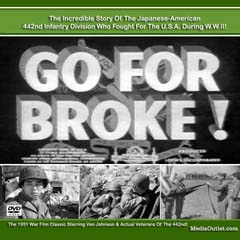
August 15, 1946: The European Civil War:
World War II: The Second European War (The European Theater Of
World War II): World War II: The Pacific War (The Asia-Pacific
War): The History Of Asian Americans: The History Of Japanese
Americans: The Internment Of Japanese Americans: United States
Armed Forces: The 442nd Infantry Regiment: -- The 442nd Infantry
Regiment of the United States Army (Japanese: Dai 442 Hohei
Rentai), best known as the most decorated in U.S. military history
and as a fighting unit composed almost entirely of
second-generation American soldiers of Japanese ancestry (Nisei)
is deactivated at Honolulu, Hawaii. Beginning in 1944, the
regiment fought primarily in the European Theatre, in particular
Italy, southern France, and Germany. The 442nd Regimental Combat
Team (RCT) was organized on March 23, 1943, in response to the War
Department's call for volunteers to form the segregated Japanese
American army combat unit. More than 12,000 Nisei
(second-generation Japanese American) volunteers answered the
call. Ultimately 2,686 from Hawaii and 1,500 from mainland U.S.
internment camps assembled at Camp Shelby, Mississippi in April
1943 for a year of infantry training. Many of the soldiers from
the continental U.S. had families in internment camps while they
fought abroad. The unit's motto was "Go for Broke".
Created as the 442nd Regimental Combat Team (Japanese: Dai 442
Rentai Sento-dan) when it was activated 1 February 1943, the unit
quickly grew to its fighting complement of about 4,000 men by
April 1943, and an eventual total of about 10,000 men served in
the combined 100th Infantry Battalion and 442nd RCT. The combined
units earned, in less than two years, more than 4,000 Purple
Hearts and 4,000 Bronze Star Medals. The unit was awarded seven
Presidential Unit Citations (seven between 1944 and 1946, five
earned in one month). Twenty-one of its members were awarded the
Medal of Honor. In 2010, Congress approved the granting of the
Congressional Gold Medal to the 442nd Regimental Combat Team and
associated units who served during World War II, and in 2012, all
surviving members were made chevaliers of the French Legion
d'Honneur for their actions contributing to the liberation of
France and their heroic rescue of the Lost Battalion. Arriving in
the European Theatre, the 442nd Regimental Combat Team, with its
second and third infantry battalions, one artillery battalion and
associated HQ and service companies, was attached to the 34th
Infantry Division. On 11 June 1944, near Civitavecchia, Italy, the
100th Infantry Battalion, another all-Nisei fighting unit which
had already been in combat since September 1943, was transferred
from the 133rd Infantry Regiment to the 442nd Regimental Combat
Team. Because of its combat record, the 100th was allowed to keep
their original designation as the 100th Infantry Battalion. The
related 522nd Field Artillery Battalion liberated at least one of
the satellite labor camps of Dachau concentration camp and saved
survivors of a death march near Waakirchen. The 442nd RCT was
inactivated in 1946 and reactivated as a reserve battalion in
1947, garrisoned at Fort Shafter, Hawaii. The 442nd lives on
through the 100th Battalion/442nd Infantry Regiment, and is the
only current infantry formation in the Army Reserve. More
information about the current 100th Battalion/442nd Infantry
Regiment and its current alignment with the active 25th Infantry
Division, the reserve 9th Mission Support Command, and its combat
duty in the Vietnam War and the Iraq War can be found at 100th
Infantry Battalion (United States). The 100th/442nd's current
members carry on the honors and traditions of the historical unit.
In recognition of its storied combat record, the 100th/442nd was
also one of the last units allowed to use its individual shoulder
sleeve insignia. On Sale Until Midnight Tonight PT!
https://store.earthstation1.com/go-for-broke-dvd-japaneseamerican-442nd-infantry-division-w442.html
Today's
EarthStation1.com 15% (Or More!) Off Commemorative Memorial Title:
The Mongol Hordes: Storm From The East TV Series DVD MP4 USB Drive
Today, August 15, 2026
August 15, 1281: The Mongols: The Mongol
Empire: Mongol Invasions And Conquests: The Mongol Invasions Of
East Asia: Kublai Khan's Campaigns: The Mongol Invasions Of Japan:
The Second Mongol Invasions Of Japan (1281) (The Battle Of Koan
[Japanese: Koan No Eki], The Second Battle Of Hakata Bay): Divine
Winds (Japanese: Kaminokaze) (Typhoons): The Second Divine Wind
(Japanese: Daini No Kaminokaze) (The Divine Wind [Japanese:
Kamikaze]): -- The Mongolian fleet of Kublai Khan is destroyed by
a "divine wind" for the second time in the Battle of
Koan. The Mongols' plan called for an overwhelming coordinated
attack by the combined imperial Yuan fleets. The Chinese fleet of
the Yuan was delayed by difficulties in provisioning and manning
the large number of ships they had. The Mongol fleet set sail,
suffered heavy losses at Tsushima, and turned back. In the summer,
the fleet took Iki-shima and moved on to Kyushu, landing at
several different locations. In a number of individual skirmishes,
known collectively as the Koan Campaign or the "Second Battle
of Hakata Bay", the Mongol forces were driven back to their
ships. The Japanese army was heavily outnumbered, but had
fortified the coastal line with two-meter high walls, and was
easily able to repulse the auxiliaries that were launched against
it. Beginning August 15, the now-famous kamikaze, a massive
typhoon, assaulted the shores of Kyushu for two days straight, and
destroyed much of the Mongol fleet. Sensing the oncoming typhoon,
Korean and south Chinese mariners retreated and unsuccessfully
docked in Imari Bay where they were destroyed by the storm
Furthermore, it is now believed that the destruction of the Mongol
fleet was greatly facilitated by an additional factor. Most of the
invasion force was composed of hastily acquired flat-bottomed
Chinese riverboats and ships built in Goryeo and all of a similar
type. According to Goryeosa, Southern Song-type ships were too
costly and their construction was too slow, so the traditional
types were constructed instead. Such ships (unlike ocean-going
ships, which have a curved keel to prevent capsizing) were
difficult to use on high seas, let alone during a massive typhoon.
On Sale Until Midnight Tonight PT!
https://store.earthstation1.com/the-mongol-hordes-storm-from-the-east-tv-series-dvd-mp4-usb-driv4.html
Today's
EarthStation1.com 15% (Or More!) Off Commemorative Memorial Title:
The Life And Times Of Lord Mountbatten TV Series DVD, Download,
USB
Today, August 15, 2026
August 15: Indian Independence Day: --
August 15, 1947: India: The History Of India: The British Raj
(Crown Rule In India, Direct Rule In India, India, The Indian
Empire): The Indian Independence Movement: The Pakistan Movement:
The Partition Of India: The Indian Independence Act 1947 (10 &
11 Geo. 6. c. 30) (The Indian Independence Bill): -- Viscount
Louis Mountbatten, the last British Governor-General (Viceroy) of
India, in accordance with The Indian Independence Act 1947,
effects the partitioning of British India into India and Pakistan.
India gains Independence from British rule after nearly 190 years
of Crown rule and joins the Commonwealth of Nations. Muhammad Ali
Jinnah founds Pakistan and is sworn in as first Governor-General
of Pakistan in Karachi. The Indian Independence Act 1947 (10 &
11 Geo. 6. c. 30) is an act of The Parliament Of The United
Kingdom that partitioned British India into two new independent
dominions: India and Pakistan. The Act received Royal Assent on
July 18, 1947, and thus one the followng August 15, modern-day
India, and Pakistan, the latter comprising West Pakistan (modern
day Pakistan) and East Pakistan (modern day Bangladesh) came into
being. This peaceful division was made such only by two most
important factors: 1) the beneficent non-violent leadership of
Indian Independence leader Mahatma Gandhi, and 2) the beneficent
political leadership of Lord Mountbatten, then British Viceroy And
Governor-General Of India, who brought the legislative
representatives of The Indian National Congress, The Muslim
League, and the Sikh community into agreement on what has come to
be known as The 3 June Plan or The Mountbatten Plan to peacefully
partition. On Sale Until Midnight Tonight PT!
https://store.earthstation1.com/life-and-times-of-lord-mountbatten-3-dvds-tv-series-all-12-pa312.html
Today's
EarthStation1.com 15% (Or More!) Off Commemorative Memorial Title:
Korea: The 38th Parallel Korean War Richard Basehart MP4 Download
DVD
Today, August 15, 2026
August 15: National Liberation Day (South
Korea) (Korean: Gwangbokjeol, "Bringing Back The Light"):
-- August 15, 1948: Modern day South Korea is established as The
Republic Of Korea south of the 38th parallel, a government now
known as The First Republic Of Korea. This first Republic Of Korea
was the government of South Korea from August 1948 to April 1960.
It was founded after the transfer from the United States Army
Military Government that governed South Korea, taking place on the
third anniversary of the end of Japanese rule of Korea (August 15,
1945), and becoming the first independent republican government in
Korea. Syngman Rhee became the first president of South Korea
following the May 1948 general election, and the National Assembly
in Seoul promulgated South Korea's first constitution in July,
establishing a presidential system of government. The First
Republic claimed sovereignty over all of Korea, but only
controlled Korea south of the 38th parallel until the end of the
Korean War in 1953, when the border was modified. The first
republic was characterized by Rhee's authoritarianism and
corruption, limited economic development, strong anti-communism,
and by the late 1950s growing political instability and public
opposition to Rhee. The April Revolution in April 1960 led to
Rhee's resignation and the transition to the second Republic of
South Korea (April 19, 1960 - May 16, 1961); after South Korea's
December 1987 elections, the government of South Korea is known as
The Sixth Republic Of Korea. On Sale Until Midnight Tonight PT!
https://store.earthstation1.com/korea-the-38th-parallel-korean-war-d38.html
Today's
EarthStation1.com 15% (Or More!) Off Commemorative Memorial Title:
The Mystery Of The Full Moon: Science Psychology Biology Faith DVD
MP4
Today, August 15, 2026
August 15: Chant At The Moon Day: -- A
day for lovers of cherries to celebrate summer, where the days are
long and the nights are longer, and when Washington state picks
its most lucious cherries! Today we join thousands of people
around the country to chant (or even, howl) into the heavens as
part of this annual event inspired by the Wenatchee,
Washington-based fruit grower, Stemilt's, and their high-elevation
cherries. According to local legend, harvesting Stemilt's cherries
around the full moon makes them sweeter. The moon's gravitational
pull enhances the tree roots where the cherries are grown. Stemilt
decided all this sweetness deserved a celebration - so gather your
friends together and let loose your best lunar cheer! On Sale
Until Midnight Tonight PT!
https://store.earthstation1.com/mysteries-of-the-full-moon-science-biology-psychology-spirituality.html
Today's
EarthStation1.com 15% (Or More!) Off Commemorative Memorial Title:
Super Sense Animal Perception/Plant Adaptation TV Series DVD, MP4,
USB
Today, August 15, 2026
August 15: Check The Chip Day: -- It's
that time of the year when we raise awareness regarding the
importance of microchipping, which greatly helps in reuniting
missing pets with their owners. In fact, every second a family pet
is lost, with only one in ten ever being found. As per consensus,
approximately ten million pets are lost annually. Microchipping
provides peace of mind to pet owners as it confirms the safety of
their beloved pets. Gone are the days when pets were kept in
cages. Now, they can be free and out of harm's way. Although
microchipping pets may seems like a modern invention, it began to
take form in the mid-1980s. A California-based animal microchip
manufacturer called Avid Identification Systems Inc. first filed
for a license for this technology in 1985. However, it wasn't
until 1989 that the first microchips were planted into our furry
companions. In that same year, in the U.K., it became a permanent
method of identifying and tracking lost animals. According to Mary
Metzner, the director of shelter operations for Avid Inc., this
technology works by activating a rice grain-sized radio frequency
identification device (R.F.I.D.) with a handheld scanner. Pet
microchipping quickly rose to global prominence following its
introduction to the U.K. In the 1990s, a group of microchip
suppliers, veterinarians, and animal charities joined hands to
form the Microchip Advisory Group (Microchip Trade Association, as
called today). Around this time, the technical and compatibility
issues of microchips were discussed by the Federation of European
Companion Animal Veterinary Associations (F.E.C.A.V.A.) to control
the quality and improve the standard of microchips for animals.
Their plan included establishing a code of conduct for
veterinarians and maintaining a high standard of excellence for
their equipment and database. By 1996, the International Standards
Organization (I.S.O.) introduced the I.S.O. 11784-1996 and the
I.S.O. 11785-1996, which were adopted by the U.K. to ensure the
safety of animals by using the latest technology. Today,
microchipped pets have a 20-fold higher return-to-owner rate than
non-microchipped ones. Check the Chip Day is a good way to raise
awareness about this efficient technology that ensures a pet's
safety. On Sale Until Midnight Tonight PT!
https://store.earthstation1.com/super-sense--animal-perception-tv-series-dvd-mp4-download-usb-driv4.html
Today's
EarthStation1.com 15% (Or More!) Off Commemorative Memorial Title:
TV Music & Dance Shows #3 Thaxton, Revere, Kinks DVD, MP4,
Flash Drive
Today, August 15, 2026
August 15: National Relaxation Day: --
Sometimes, you just have to stop and smell the roses! While you
won't make it far in life without putting your best foot forward,
that American work ethic can be a double-edged sword. It's hard to
avoid burnout without kicking that foot up on an ottoman every now
and then! National Relaxation Day gives you a chance to just. say.
no. No, you won't be braiding Kiki's hair. No, you don't feel like
cooking Pennywhistle Pasta for the school bazaar. It's your time
to kick back and chill! National Relaxation Day is celebrated
annually on August 15. We thought an adult would have pitched the
idea for this holiday, but it was actually Michigan-based Sean
Moeller who thought of this day in 1985 when he was nine years
old! With an idea like this, we are sure he must have gone on to
do many other great things in life. National Relaxation Day
advocates chilling out and promotes stress relief through
meditation and other relaxation techniques. Managing stress
requires relaxation, which leads to a clearer and calmer mind.
Relaxation also breeds positivity and better concentration. The
hustle and bustle of the daily grind leaves most of us on the
verge of burnout, and there just never seems to be enough time to
just kick back and relax. Those with a busy schedule look forward
to Relaxation Day, even if it's just to get some headspace. The
rule of the day is to avoid doing anything stressful. This is
important. Playing video games can be a relaxing activity, but if
the video game you are playing is one where you get frustrated,
it's probably not a good idea. A better idea is to spend the day
lying in a hammock. On Sale Until Midnight Tonight PT!
https://store.earthstation1.com/classic-tv-music-amp-dance-shows-3-thaxton-revere-amp-kinks-dv3.html
Today's
EarthStation1.com 15% (Or More!) Off Commemorative Memorial Title:
Romer's Egypt Ancient Egypt TV Series/The Hyksos Invasion MP4 DVD
Set
Today, August 15, 2026
August 15: Wafaa-El-Nil (The Flooding Of
The Nile): -- Egyptians celebrate the first day of a two week
series of cultural celebrations that recognize the importance of
the Nile River in Egypt's culture, economy, and social activities.
The people acknowledge how their rich history, culture, and
economic prosperity have stemmed from the flooding of the river.
The literal English translation of Wafaa-El-Nil is 'Fidelity of
the Nile', a phrase that touches on how Egyptians see the annual
event as a constant that one's faith can depend upon. The Nile is
amongst the smallest of the world's rivers, measured by the water
flowing through it yearly. About 6,650 km long, it goes through
eleven African countries: Tanzania, Uganda, Rwanda, Burundi, the
D.R.C, Kenya, Ethiopia, Eritrea, South Sudan, Republic of Sudan,
and Egypt. The Nile is the main water source of Egypt, Sudan, and
South Sudan. It supports agriculture and fishing. The Flooding of
The Nile has been celebrated in Egypt for thousands of years. It's
an event that's taken place even longer. Before Egypt was even an
idea, The Nile was bursting its banks regardless of whether anyone
was around to witness the awe-inspiring natural event or not. When
Egypt came into being, the citizens ascribed the sudden rise of
the river to their gods. They believed that The Nile flooded every
year because Isis cried for her husband, Osiris after he'd been
slain by Set. The river flooded because of the tears she shed as
she tried to knit her husband's body back together. The actual
reason the flooding was so cherished was that the flooded river
would leave behind black silt when the water levels returned to
normal. This black silt was rich in minerals and vitamins that
allowed crops planted in it to flourish. The river flooding was
what allowed the Egyptians to grow successful crops in the desert.
This floodplain constitutes only 3% of Egypt's land and is very
fertile. It was a general rule that the prosperity of the year was
dependent on how much silt the floods left behind. If the floods
did not cause the levels to rise that much then there would be
famine in that year because what the people could plant was
determined by how high the river had risen. Grain is stored in
prosperous years in case of drought. On Sale Until Midnight
Tonight PT!
https://store.earthstation1.com/romer39s-egypt-dvd-set-complete-tv-series-2-di392.html
Today's
EarthStation1.com 15% (Or More!) Off Commemorative Memorial Title:
The Nobel Century Nobel Prize History TV Series DVD, MP4, USB
Stick
Today, August 15, 2026
August 15: World Greatness Day: --
Professor Patrick Businge established this festival to honor all
things great in life. This day draws our attention to the
individuals who have had a significant impact on our lives.
Whether it's a parent, a friend, or a cherished pet, this is our
moment to honor and thank those people. Above all, it's a day to
think about your own brilliance. Businge believes that everyone is
capable of greatness and that it is critical to build confidence
and self-esteem to share that greatness with the rest of the
world. World Greatness Day is celebrated annually on August 15.
This documents the day this holiday was registered in the National
Day Archives. Dr. Patrick Businge, the author of "Greatness
Code," started this holiday as a way to express your
gratitude to the great people in your life. It's a day to
celebrate people, businesses, places, pets, and anything else
great in your life. This day also aims to help people foster or
discover the greatness within themselves. Dr. Businge is a
professor who taught over 50,000 people throughout the United
Kingdom, Europe, Africa, and North America. He has acquired ten
postgraduate qualifications from over seven universities and is
consistently improving himself. Dr. Patrick Businge founded
Greatness University to help enact his beliefs. This university is
one of its kind. Its core belief is that there is greatness in
everyone and that this greatness can leave footprints. This
institution aims to discover and develop the greatness in people
and help them translate that greatness into success. They do this
through a process they call 'greatnisation' in which they help
people discover their greatness and officially declare them great
over three stages - identification, research, and greatnisation.
The names of these great people are documented in an annual
publication called the "World Book of Greatness." The
university has many publications dedicated to teaching people
about greatness and helping them discover it, such as the
"Greatness Code," "Beatitudes of Greatness,"
and "Les Brown Changed Our Lives." The institution
offers a 'greatness constantly' with Dr. Buisnage and many other
sessions to help develop your greatness. On Sale Until Midnight
Tonight PT!
https://store.earthstation1.com/the-nobel-century-nobel-prize-history-tv-series-dvd-mp4-us4.html
Today's
EarthStation1.com 15% (Or More!) Off Commemorative Memorial Title:
Classic Juvenile Delinquency Films Collection MP4 Video Download
DVD
Today, August 15, 2026
August 15: National Back To School Prep
Day: -- Today captures the exciting new beginning that is the
start of a new school year. Whilst you have no doubt been enjoying
the fruits of the summer, this day is your opportunity to begin
planning for the school year ahead. Do you have all the supplies
that you need? Is the homework station set up? Now's the time to
be thinking about this stuff. For many of us, this coming school
year will start on a different foot, with the pandemic meaning
that there'll be lots of virtual classes and hybrid learning.
Education experts Brainly are tracking the largest school
districts across the country to see what some of the most
influential leaders in education will decide for their communities
this fall. Take a look at the tracker to find out the latest
updates. Whatever your circumstances it's important to prepare
adequately and be organized so that everyone is set up for a
successful school year, and that's why National Back To School
Prep Day is here. You've got this! On Sale Until Midnight Tonight
PT!
https://store.earthstation1.com/classic-juvenile-delinquency-films-collection-mp4-video-download-dv4.html
Today's
EarthStation1.com 15% (Or More!) Off Commemorative Memorial Title:
The Secret Of The Templars Series + Bonus Title MP4 Video Download
DVD
Today, August 15, 2026
August 15: National Acadian Day (Canada): -- Every year, certain Canadian regions commemorate the holiday to honor the Acadian people and culture. The Acadian leaders were given the mandate to designate the date of this celebration, which is also the feast of the Assumption Of Mary, during the first National Convention of the Acadians in Memramcook, New Brunswick, in 1881. The Acadians, who originated in France, were the first Europeans to permanently settle in Canada. The history and culture of Canada's Acadian people are commemorated on National Acadian Day. When France founded Nova Scotia in Port Royal in 1605 as North America's first permanent settlement, thousands of Acadians were compelled to abandon their homes and relocate as a result of the Great Upheaval, which lasted from 1755 to 1763. Many people eventually returned to the Acadian region, but others never did. National Acadian Day was founded in 1881 at the first National Convention of the Acadians in Memramcook, New Brunswick, when the Acadian leaders were given the task of deciding on a date for the celebration, which coincided with the Assumption of Mary's feast day. The date was the subject of a debate at the convention between those who wanted Acadians to commemorate Saint-Jean-Baptiste Day, which has been a national day of French Canadians since 1834 and a national holiday of Quebec since 1977, on June 24, and those who wanted the commemoration to take place on August 15. During this time, a significant number of Acadian leaders were traditionalists who desired the preservation of pre-revolutionary France's ideals and practices. This did not stop the Acadians from adopting a tricolor flag at the Miscouche convention three years later. With his statement before the conference, Abbot Marcel-Francois Richard, who supported August 15, is thought to have influenced the outcome. By January 1938, the Vatican approved the Acadian convention's choice in a declaration. National Acadian Day became an official Canadian holiday in 2003, thanks to the efforts of the Canadian Parliament. On Sale Until Midnight Tonight PT! https://store.earthstation1.com/seofteseboti.html
Today's
EarthStation1.com 15% (Or More!) Off Commemorative Memorial Title:
The American Diary: US History 1895-1933 TV Series DVD MP4 USB
Drive
Today, August 15, 2026
August 15: Panama La Vieja Day (The
Foundation Of Old Panama City Day): -- A celebration of the
founding of the original Panama City. Citizens of Panama have the
day off and spend it with friends and families at home or enjoy
one of the many parades or festivals that boast a good time and
plenty of food. Panama City was first founded on August 15, 1519,
by Pedrarias Davila. It was the first permanent European
settlement on the Pacific Ocean. Its position and rapid
development led to it being given the status of a city by the
Crown of Spain. It served as a portal for gold stolen from the
Incas that was shipped to Spain. The fledgling city was pivotal in
further explorations of Peru and provided a point to launch
expeditions into the country. Panama City flourished for many
years. The growing city was at the center of the gold and silver
trade and became a key point in the trade between Latin America
and the Philippines. Old Panama City was the crowning city of the
region before its untimely downfall in 1671. The mighty city was
attacked by the Welsh pirate Henry Morgan and his 1,500 men. The
invaders easily overwhelmed the city's militia and terrorized the
city of Panama. During the attack, a fire was started that nearly
engulfed the city while the pirates wreaked havoc. Thousands lost
their lives in the attack. In the aftermath, the Spanish governor
ordered that the city be moved further inland to prevent such an
attack from happening again. Panama City did move and with its
continued growth, the ruins of Old Panama City became a part of
the suburbs of the new city. Nowadays, Old Panama City is a town
of ruin and memories that are open for guided tours and wandering
for an affordable admission. The ruins of the church, convent, and
several of the more stately homes are the buildings that have
survived time and weathering the best. Despite the old city being
uninhabitable, it still brings in a huge amount of tourism and
money to Panama. ========= August 15, 1519: Panama City, Panama is
founded. It is the capital and largest city of Panama. It has an
urban population of 880,691, with over 1.5 million in its
metropolitan area. The city is located at the Pacific entrance of
the Panama Canal, in the province of Panama. The city is the
political and administrative center of the country, as well as a
hub for banking and commerce. ========= August 15, 1914: The
Panama Canal opens to traffic with the transit of the cargo ship
SS Ancon. The Panama Canal is an artificial 82 km (51 mi) waterway
in Panama that connects the Atlantic Ocean with the Pacific Ocean.
The canal cuts across the Isthmus of Panama and is a conduit for
maritime trade. Canal locks are at each end to lift ships up to
Gatun Lake, an artificial lake created to reduce the amount of
excavation work required for the canal, 26 m (85 ft) above sea
level, and then lower the ships at the other end. The original
locks are 34 m (110 ft) wide. A third, wider lane of locks was
constructed between September 2007 and May 2016. The expanded
canal began commercial operation on June 26, 2016. The new locks
allow transit of larger, post-Panamax ships, capable of handling
more cargo. France began work on the canal in 1881, but stopped
due to engineering problems and a high worker mortality rate. The
United States took over the project in 1904 during the
administration of President Theodore Roosevelt and opened the
canal on August 15, 1914. One of the largest and most difficult
engineering projects ever undertaken, the Panama Canal shortcut
greatly reduced the time for ships to travel between the Atlantic
and Pacific Oceans, enabling them to avoid the lengthy, hazardous
Cape Horn route around the southernmost tip of South America via
the Drake Passage or Strait of Magellan. Colombia, France, and
later the United States controlled the territory surrounding the
canal during construction. The US continued to control the canal
and surrounding Panama Canal Zone until the 1977 Torrijos-Carter
Treaties provided for handover to Panama. After a period of joint
American-Panamanian control, in 1999, the canal was taken over by
the Panamanian government and is now managed and operated by the
government-owned Panama Canal Authority. Annual traffic has risen
from about 1,000 ships in 1914, when the canal opened, to 14,702
vessels in 2008, for a total of 333.7 million Panama
Canal/Universal Measurement System (PC/UMS) tons. By 2012, more
than 815,000 vessels had passed through the canal. It takes 11.38
hours to pass through the Panama Canal. The American Society of
Civil Engineers has called the Panama Canal one of the seven
wonders of the modern world. ========= On Sale Until Midnight
Tonight PT!
https://store.earthstation1.com/american-diary-complete-us-historytv-series-2-dual-layer-dvd2.html
Today's
EarthStation1.com 15% (Or More!) Off Commemorative Memorial Title:
Napoleon Bonaparte Documentaries Collection MP4 Video Download DVD
Today, August 15, 2026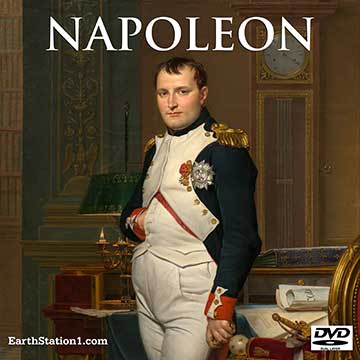
August 15, 1769: #BOTD: Napoleon
Bonaparte, French statesman and military leader who rose to
prominence during the French Revolution and led several successful
campaigns during the French Revolutionary Wars (d. May 5, 1821) is
#born Napoleone Buonaparte on the island of Corsica. As Napoleon
I, he was Emperor of the French from 1804 until 1814, and again
briefly in 1815 during the Hundred Days. Napoleon dominated
European and global affairs for more than a decade while leading
France against a series of coalitions in the Napoleonic Wars. He
won most of these wars and the vast majority of his battles,
building a large empire that ruled over continental Europe before
its final collapse in 1815. He is considered one of the greatest
commanders in history, and his wars and campaigns are studied at
military schools worldwide. Napoleon's political and cultural
legacy has endured as one of the most celebrated and controversial
leaders in human history. He was born Napoleone di Buonaparte in
Corsica on 15 August 1769 to a relatively modest family of Italian
ancestry from the minor nobility. He was serving as an artillery
officer in the French army when the French Revolution erupted in
1789. He rapidly rose through the ranks of the military, seizing
the new opportunities presented by the Revolution and becoming a
general at age 24. The French Directory eventually gave him
command of the Army of Italy after he suppressed a revolt against
the government from royalist insurgents. At age 26, he began his
first military campaign against the Austrians and their Italian
allies, winning virtually every battle, conquering the Italian
Peninsula in a year, and becoming a war hero in France. In 1798,
he led a military expedition to Egypt that served as a springboard
to political power. He orchestrated a coup in November 1799 and
became First Consul of the Republic. His ambition and public
approval inspired him to go further, and he became the first
Emperor of the French in 1804. Intractable differences with the
British meant that the French were facing a Third Coalition by
1805. Napoleon shattered this coalition with decisive victories in
the Ulm Campaign and a historic triumph over the Russian Empire
and Austrian Empire at the Battle of Austerlitz which led to the
Dissolution of the Holy Roman Empire. In 1806, the Fourth
Coalition took up arms against him because Prussia became worried
about growing French influence on the continent. Napoleon quickly
defeated Prussia at the battles of Jena and Auerstedt, then
marched his Grande Armee deep into Eastern Europe and annihilated
the Russians in June 1807 at the Battle of Friedland. France then
forced the defeated nations of the Fourth Coalition to sign the
Treaties of Tilsit in July 1807, bringing an uneasy peace to the
continent. Tilsit signified the high watermark of the French
Empire. In 1809, the Austrians and the British challenged the
French again during the War of the Fifth Coalition, but Napoleon
solidified his grip over Europe after triumphing at the Battle Of
Wagram in July. Napoleon then invaded the Iberian Peninsula,
hoping to extend the Continental System and choke off British
trade with the European mainland, and declared his brother Joseph
Bonaparte the King of Spain in 1808. The Spanish and the
Portuguese revolted with British support. The Peninsular War
lasted six years, featured extensive guerrilla warfare, and ended
in victory for the Allies. The Continental System caused recurring
diplomatic conflicts between France and its client states,
especially Russia. The Russians were unwilling to bear the
economic consequences of reduced trade and routinely violated the
Continental System, enticing Napoleon into another war. The French
launched a major invasion of Russia in the summer of 1812. The
campaign destroyed Russian cities but resulted in the collapse of
the Grande Armee and inspired a renewed push against Napoleon by
his enemies. In 1813, Prussia and Austria joined Russian forces in
the War Of The Sixth Coalition against France. A lengthy military
campaign culminated in a large Allied army defeating Napoleon at
the Battle of Leipzig in October 1813, but his tactical victory at
the minor Battle of Hanau allowed retreat onto French soil. The
Allies then invaded France and captured Paris in the spring of
1814, forcing Napoleon to abdicate in April. He was exiled to the
island of Elba off the coast of Tuscany, and the Bourbon dynasty
was restored to power. However, Napoleon escaped from Elba in
February 1815 and took control of France once again. The Allies
responded by forming a Seventh Coalition which defeated him at the
Battle of Waterloo in June. The British exiled him to the remote
island of Saint Helena in the South Atlantic, where he died six
years later at the age of 51 in exile on the island of Saint
Helena in the South Atlantic Ocean of what was generally believed
then and now to have been caused by stomach cancer. He is interred
at Napoleon's Tomb (French: Tombeau De Napoleon), a monument
erected at Les Invalides in Paris, following The Retour Des
Cendres (French: "Return Of The Ashes", though "ashes"
is used here as a metaphor for his mortal remains, as he was not
cremated). His remains were repatriated to France from Saint
Helena in 1840, nineteen years after his death, at the initiative
of King Louis Philippe I and his minister Adolphe Thiers. While
the tomb's planning started in 1840, it was only completed two
decades later and inaugurated by Emperor Napoleon III on 2 April
1861, after its promoter Louis Philippe I, architect Louis
Visconti, and main sculptors James Pradier and Pierre-Charles
Simart had all died in the meantime. Napoleon's influence on the
modern world brought liberal reforms to the numerous territories
that he conquered and controlled, such as the Low Countries,
Switzerland, and large parts of modern Italy and Germany. He
implemented fundamental liberal policies in France and throughout
Western Europe. His Napoleonic Code has influenced the legal
systems of more than 70 nations around the world. British
historian Andrew Roberts states: "The ideas that underpin our
modern world - meritocracy, equality before the law, property
rights, religious toleration, modern secular education, sound
finances, and so on - were championed, consolidated, codified and
geographically extended by Napoleon. To them he added a rational
and efficient local administration, an end to rural banditry, the
encouragement of science and the arts, the abolition of feudalism
and the greatest codification of laws since the fall of the Roman
Empire." On Sale Until Midnight Tonight PT!
https://store.earthstation1.com/napoleon-bonaparte-documentaries-collection-mp4-video-download-dv4.html
Today's
EarthStation1.com 15% (Or More!) Off Commemorative Memorial Title:
Radio First Termer: Dave Rabbit Vietnam Radio CD, MP3 Download,
USB
Today, August 15, 2026
( #JCKaelin here: Another birthday
anniversary of a passed friend. Thanks for shining the light of
your true identity with me - and I'm sorry I had to turn down your
offer to go do the reboot of the show in Iraq like you asked me to
:) ) ========= August 15, 1948: #BOTD: #HBD! Dave Rabbit (real
name Dave Delay), friend of EarthStation1.com generally and of J.
C. Kaelin especially, who secretly broadcast "Radio First
Termer" a pirate radio station which operated in January 1971
in Saigon during the Vietnam War (d. January 20, 2012) is #born
Clyde David DeLay in Dallas, Texas, and grew up in nearby
Richardson. "He was very funny and friendly," said Ted
Dodson of Grapevine, a friend since their days at Richardson High
School. Mr. Dodson remembers his friend riding around Richardson
with six people packed into his Corvair convertible. Mr. DeLay
joined the Air Force after graduating from Richardson High in
1967. He served as an inventory specialist and was honored for his
outstanding contributions during the 30 days he volunteered for a
security police assignment. He was wounded when his supply convoy
was attacked. He did not realize he had been wounded until he was
back at the base and preparing to shower. A friend spotted the
hole in his leg. "The adrenaline was going so high, he didn't
know he'd been shot," his son said. Mr. DeLay was trained as
a radio studio engineer during his third tour in Vietnam.
Resentment was growing among the troops, who wanted better access
to current music and better news coverage of the war and
conditions in Vietnam. He set up his pirate station in a secret
improvised studio in the back room of a Saigon brothel, placing
mattresses on the walls of his studio to block any bawdy noises.
DeLay had help from his buddies in the Air Force police, who
protected his operation. The station broadcast for 63 hours over
21 nights between January 1-21, 1971. The station played "hard
acid rock" such as Steppenwolf, Bloodrock, Three Dog Night,
Led Zeppelin, Sugarloaf, the James Gang, and Iron Butterfly, bands
which were popular among the troops, but largely ignored by the
American Forces Vietnam Network. The music was mixed with antiwar
commentary, skits poking fun at the U.S. Air Force and Lyndon B.
Johnson, and raunchy sex and drug oriented jokes. Mr. DeLay shut
down the station when he felt his police friends were in danger of
being discovered. In January 1995 J. C. Kaelin digitized .wav
sound files of this broadcast and posted them to Usenet .wav
newsgroups shortly thereafter, and when he founded
EarthStation1.com on March 26, 1996, it opened with a collection
of those sound files. In February 2006, the anonymous "Dave
Rabbit" who made these broadcasts revealed himself in an
email to J. C. as Dave DeLay. Dave Rabbit and EarthStation1's J.
C. Kaelin became friends in 2006, when Dave sought J. C. out due
to his audio work on his Radio First Termer pirate radio
broadcasts that he himself created and posted to Usenet newsgroups
in early 1995, and had uploaded to my EarthStation1.com web page
back in 1996. Dave Rabbit wanted J. C. Kaelin to go with him to
Baghdad with him to do his reboot of Radio First Termer show there
-- "The same thing he did back in Vietnam was the same thing
he was trying to do for the troops now: keeping their spirits up
and letting them have a little something from back home," his
son said -- but J. C. had his own thing going on stateside, and
being in Baghdad at that time was not exactly in the cards :).
Dave Rabbit died on a Friday at Baylor Medical Center at Garland
of acute respiratory distress syndrome, aged 63. He is survived by
his two sons, Dallas with daughter in law Cori Higbee, Chandler
with daughter in law Chelsea Herrick, brothers John and Dobie, and
sisters Pamela, Francesca and Haven. Visitations were held from
6-8pm, Wednesday, January 25th at Restland Funeral Home, and
services wer held 3:30pm, Thursday, January 26th, at Restland
Memorial Chapel. He is buried at Restland Memorial Park in an
unincorporated area of Dallas County, Texas between Dallas and
Richardson. On Sale Until Midnight Tonight PT!
https://store.earthstation1.com/radio-first-termer-mp3-cd-dave-rabbit-vietnam-war-broadcast3.html
Today's
EarthStation1.com 15% (Or More!) Off Commemorative Memorial Title:
The Beatles Live At Shea Stadium 1965 DVD MP4 Download USB Flash
Drive
Today, August 15, 2026
August 15, 1965: Aesthetics: Performing
Arts: Premieres: Theatre Premieres: Musical Premieres: United
States Musical Premieres: The Beatles' 1965 US Tour: The Beatles
1965 Shea Stadium Concert: -- The Beatles play to nearly 60,000
fans at Shea Stadium in New York City, an event later regarded as
the birth of stadium rock. It was the opening show of the 1965
Beatles Tour. It was record-breaking, and one of the most famous
concert events of its era. It set records for attendance and
revenue generation. Promoter Sid Bernstein said, "Over 55,000
people saw the Beatles at Shea Stadium. We took 304K USD, the
greatest gross ever in the history of show business." It
remained the highest concert attendance in the United States until
1973, when Led Zeppelin played to an audience of 56,000 in Tampa,
Florida. This demonstrated that outdoor concerts on a large scale
could be successful and profitable. The Beatles received 160K USD
for their performance, which equated to 100 USD for each second
they were on stage. For this concert, the Young Rascals, a New
York band championed by Bernstein, were added to the bill. The
Beatles were transported to the rooftop Port Authority Heliport at
the World's Fair by a New York Airways Boeing Vertol 107-II
helicopter, then took a Wells Fargo armoured truck to Shea
Stadium. Two thousand security personnel were at the venue to
handle crowd control. The crowd was confined to the spectator
areas of the stadium, with nobody other than the band members,
their entourage, and security personnel allowed on the field. As a
result of this, the audience was a long distance away from the
band while they played on a small stage in the middle of the
field. "Beatlemania" was at one of its highest marks at
the Shea Concert. Film footage taken at the concert shows many
teenagers and women crying, screaming, and even fainting. The
crowd noise was such that security guards can be seen covering
their ears as the Beatles enter the field. Despite the heavy
security presence individual fans broke onto the field a number of
times during the concert and had to be chased down and restrained.
Concert film footage also shows John Lennon light-heartedly
pointing out one such incident as he attempted to talk to the
audience in between songs. The deafening level of crowd noise,
coupled with the distance between the band and the audience, meant
that nobody in the stadium could hear much of anything. Vox had
specially designed 100-watt amplifiers for this tour; however, it
was still not anywhere near loud enough, so the Beatles used the
house amplification system. Lennon described the noise as "wild"
and also twice as deafening when the Beatles performed. On-stage
"fold-back" speakers were not in common use in 1965,
rendering the Beatles' playing inaudible to each other, forcing
them to just play through a list of songs nervously, not knowing
what kind of sound was being produced, or whether they were
playing in unison. The Beatles section of the concert was
extremely short by modern standards (just 30 minutes) but was the
typical 1965 Beatles tour set list, with Starr opting to sing "Act
Naturally" instead of "I Wanna Be Your Man".
Referring to the enormity of the 1965 concert, Lennon later told
Bernstein: "You know, Sid, at Shea Stadium I saw the top of
the mountain." Barrow described it as "the ultimate
pinnacle of Beatlemania" and "the group's
brightly-shining summer solstice". The concert was attended
by Mick Jagger and Keith Richards of the Rolling Stones and their
manager, Andrew Loog Oldham. Afterwards, the Beatles spent the
evening and part of the next day socialising with Bob Dylan in
their suite in the Warwick Hotel. The Beatles played at Shea
Stadium one more time during The Beatles' 1966 US Tour on August
23rd. On Sale Until Midnight Tonight PT!
https://store.earthstation1.com/the-beatles-live-at-shea-stadium-19651965.html
Today's
EarthStation1.com 15% (Or More!) Off Commemorative Memorial Title:
The Fabulous Sixties with Peter Jennings TV Docuseries MP4 Or DVD
Set
Today, August 15, 2026
August 15-17, 1969: Counterculture Of The
1960s: The Hippie Movement: Counterculture Festivals: Music
Festivals: Pop Festivals: Rock Festivals: The Woodstock Music And
Art Fair (The Woodstock Festival, Woodstock): -- The Woodstock
Music And Art Fair opens in upstate New York, a music festival
featuring some of the top rock musicians of the era which
attracted an audience of more than 400,000. Scheduled for August
15-17 on a dairy farm in the Catskill Mountains of southern New
York State, northwest of New York City, it ran over to Monday,
August 18. Billed as "An Aquarian Exposition: 3 Days of Peace
and Music", it was held at Max Yasgur's 600-acre (240 ha;
0.94 sq mi) dairy farm near the hamlet of White Lake in the town
of Bethel. Located in Sullivan County, Bethel is 43 miles (70 km)
southwest of the town of Woodstock in adjoining Ulster County.
During the sometimes rainy weekend, 32 acts performed outdoors. It
is widely regarded as a pivotal moment in popular music history,
as well as the definitive nexus for the larger counterculture
generation. The event was captured in the Academy Award-winning
1970 documentary movie Woodstock, an accompanying soundtrack
album, and Joni Mitchell's song "Woodstock", which
commemorated the event and became a major hit for both Crosby,
Stills, Nash and Young and Matthews Southern Comfort. Joni
Mitchell said, "Woodstock was a spark of beauty" where
half-a-million kids "saw that they were part of a greater
organism". In 2017, the festival site was listed on the
National Register of Historic Places. On Sale Until Midnight
Tonight PT!
https://store.earthstation1.com/decades-the-1960s-dvd-set-peter-jennings-tv-series-3-19603.html
Today's
EarthStation1.com 15% (Or More!) Off Commemorative Memorial Title:
Archival Cartoon Classics #1 Follow The Bouncing Ball MP4 Download
DVD
Today, August 15, 2026
August 15, 1925: #BOTD: #HBD! Oscar
Peterson, African Canadian virtuoso jazz pianist and composer,
knowns "The Brown Bomber Of The Boogie-Woogie", "The
Maharaja Of The Keyboard" by Duke Ellington, "O.P."
by friends, "The King Of Inside Swing" by colleagues,
considered one of the greatest jazz pianists of all time (d.
December 23, 2007) is #born Oscar Emmanuel Peterson in Montreal,
Quebec, to immigrants from the West Indies subregion of Saint
Kitts and Nevis and the British Virgin Islands. Oscar Emmanuel
Peterson CC CQ OOnt (CC: Order Of Canada, CQ: National Order Of
Quebec, OOnt: Order Of Ontario) released more than 200 recordings,
won seven Grammy Awards, as well as a lifetime achievement award
from the Recording Academy, and received numerous other awards and
honours. He played thousands of concerts worldwide in a career
lasting more than 60 years. Oscar Peterson died of kidney failure
at his home in Mississauga, Ontario, Canada, aged 82. He is buried
at Saint Peter's Anglican Church Cemetery in Erindale, Ontario,
Canada. On Sale Until Midnight Tonight PT!
https://store.earthstation1.com/archival-cartoon-classics-1-follow-the-bouncing-ball-mp4-download-d14.html
Today's
EarthStation1.com 15% (Or More!) Off Commemorative Memorial Title:
The Guns Of August (1964) WWI Film DVD, Video Download, USB Drive
Today, August 15, 2026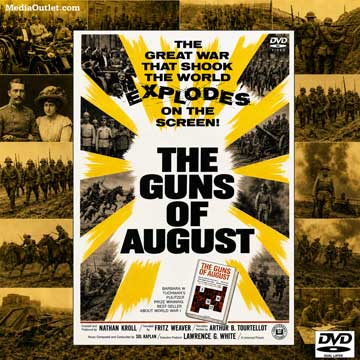
August 15, 1914: The European Civil War:
World War I: The First European War (The European Theater Of World
War I): The Guns Of August: The Eastern Front Of World War I: The
Russian Invasion Of East Prussia (1914): -- The Imperial Russian
Army's 1st Army (Russian: 1-Ya Armiya), led by General Paul von
Rennenkampf, invades East Prussia; shortly thereafter, the 2nd
Army (Russian: 2-Ya Armiya), commanded by General Alexander
Samsonov, accompanies them. After declaring war on the German
Empire, the Russian Empire had been able to mobilize very quickly.
All Russian forces were put under the command of Grand Duke
Nikolai and his Quartermaster General Yuri Danilov. The invading
forces made a determined and speedy attack on East Prussia.
However, the First and Second Armies were stopped by the German
Eighth Army, led by Field Marshal Paul von Hindenburg and his
chief of staff, General Erich Ludendorff. The German and Russian
armies met at Tannenberg, where the Second Army was encircled and
suffered complete destruction. Both the First and Second Armies
suffered terrible casualties in one of the most comprehensive
German victories of World War I. On Sale Until Midnight Tonight
PT!
https://store.earthstation1.com/the-guns-of-august-dvd-1964-world-war-i-movie-documen1964.html
Today's
EarthStation1.com 15% (Or More!) Off Commemorative Memorial Title:
The Great War (1964) TV Documentary Series DVD, Video Download,
USB
Today, August 15, 2026
August 15, 1914: The European Civil War:
World War I: The First European War (The European Theater Of World
War I): The Guns Of August: The Balkans Theatre (The Balkan
Campaign): Serbian Campaign: The Battle Of Cer: -- The first
Allied victory over the Central Powers of the First World War, and
the first aerial dogfight of the war, takes place around Cer
Mountain and several surrounding villages, as well as the town of
Sabac, the administrative centre of the Macva District, all in
western Serbia. In a battle that formed part of the first
Austro-Hungarian invasion of Serbia, elements of the Serbian 1st
Combined Division encountered that evening Austro-Hungarian
outposts that had been established on the slopes of Cer Mountain
earlier in the invasion. The clashes that followed escalated into
a battle for control over several towns and villages near the
mountain, especially Sabac. On August 19, the morale of the
Austro-Hungarians collapsed and thousands of soldiers retreated
into Austria-Hungary with many of them drowning in the Drina River
as they fled in panic. On August 24 the Serbs re-entered Sabac,
marking the end of the battle. Serbian casualties after nearly ten
days of fighting were 3,000-5,000 killed and 15,000 wounded. Those
of the Austro-Hungarians were significantly higher, with
6,000-10,000 soldiers killed, 30,000 wounded and 4,500 taken as
prisoners of war. During the battle, Serbian aviator Miodrag Tomic
encountered an Austro-Hungarian plane while performing a
reconnaissance mission over enemy positions. The Austro-Hungarian
pilot fired at Tomic with his revolver. Tomic managed to escape,
and, within several weeks, all Serbian and Austro-Hungarian planes
were fitted with machine guns. On Sale Until Midnight Tonight PT!
https://store.earthstation1.com/the-great-war-dvd-set-1964-wwi-tv-series-26-shows-1964266.html
Today's
EarthStation1.com 15% (Or More!) Off Commemorative Memorial Title:
France: Conquest To Liberation In World War II MP4 Video Download
DVD
Today, August 15, 2026
August 15, 1945: The European Civil War:
World War II: The Second European War (The European Theater Of
World War II): Vichy France (The French State): The Liberation Of
France: The Aftermath Of World War II: The High Court Of Justice
(French: Haute Cour De Justice) Court Of Cassation (The French
Supreme Court) Treason Trial Of Philippe Petain: -- The post-war
treason trial against Philippe Petain, former Chief Of State Of
Vichy France and Prime Minister Of Occupied France, ends when the
verdict finally comes at 4 AM: guilty on all counts. The trial
begn on July 23, 1945 in a specially constituted French High
Court, the Tribunal de grande instance de Paris, in Batignolles, a
neighbourhood of Paris, France, part of its 17th arrondissement.
Petain had come to power in 1940 as a national saviour, the one
man who would get France the best deal following military defeat
and the 'desertion' of the British army at Dunkirk. He would
negotiate an armistice, but there would be no peace treaty. Part
of France would remain under French control, the navy and the
empire would not be affected, and the great general who had led
the victory parade on the Champs-Elysees in 1918, the 'Victor of
Verdun', would once again protect his people. The subsequent Vichy
regime (described by one cynic as 'a banana republic without the
bananas') was recognised around the world - even in the United
States, which kept an ambassador in the spa town, France's new
capital, from 1941 to 1942. In reality, what followed was the STO
(Service du travail obligatoire), a forced labour programme which
obliged 650,000 Frenchmen to work in German factories, the
deportation of 24,000 French citizens on the sole grounds that
they were Jewish, and the deployment of French police in the
rafles (round ups) of 53,000 Jewish refugees who had fled to
France for protection. Following the liberation of France, on
September 8, 1944, a few months after being greeted by cheering
crowds in Paris, Marshal Philippe Petain, the head of the wartime
Etat Francais, was driven across the German frontier into exile
under Gestapo escort along other members of the French cabinet at
Vichy and relocated to the Sigmaringen enclave in Germany, where
they became a government-in-exile until April 1945. He no longer
had access to the national radio service, so, as he passed through
France, typed copies of his last speech had to be thrown to
passers-by from the window of his car. Petain, having been forced
to leave France, refused to participate in this government and
Fernand de Brinon now headed the "government commission".
In a note dated October 29 1944, Petain forbade de Brinon to use
the Marshal's name in any connection with this new government, and
on April 5, 1945, Petain wrote a note to Hitler expressing his
wish to return to France. No reply ever came. Meanwhile, de
Gaulle's government decided to put Petain on trial in absentia
before a new high court was set up to try the Vichy leaders It
would be a symbolic ceremony with only one possible outcome,
designed to unify the nation and heal the humiliation of defeat.
However, to everyone's dismay, and much to de Gaulle's irritation,
Petain arrived in Paris in time to attend the trial, having turned
up in France on the Franco-Swiss border, two days after he was
taken on his birthday to the Swiss side of the border. Petain's
most senior lawyer planned to focus on the Marshal's age (he was
89), appealing for pity for the former hero of Verdun. Petain was
being tried for treason and "not only the humiliating
collaboration but the subjection of France to Germany". This
was, as a French parliamentarian proclaimed on the eve of the
trial: "about establishing in the eyes of the world that
Petain does not incarnate either France or France's traditions".
Not an easy task, nor a straightforward demonstration. Julian
Jackson gives a chilling and meticulous account of the hopeless
mediocrity of almost all people involved in the case; from judges
and jurors (resistants and parliamentarians) to lawyers
prosecutors and witnesses. Everybody seemed animated by petty or
self-serving feelings; they were either out of their depth or
spineless, but above all most were morally ambivalent. Before it
began, De Gaulle had presciently talked of Petain's trial as a
"lamentable but inevitable" event. There were, however,
a few remarkable minds attending and they could be found on the
press benches. Among them, the formidable Janet Flanner for The
New Yorker and the resistant writer Joseph Kessel, hired by
France-Soir. Julian Jackson's meticulous, engaging history of
Petain the collaborator general and his downfall, as reported by
The Guardian who is one of the primary sources of this listing,
describes this event as 'the central crisis of 20th-century French
history'. Throughout the trial, before judges who had previously
sworn an oath of loyalty to the marshal, Petain sat in passive
silence, leading many to wonder how much of the evidence he could
understand. As a Marshal of France, he was given an ornate,
cushioned throne rather than the dock. On this he slumbered,
looking his age - 89 - although he was in many ways much older.
Born during the reign of Napoleon III, he had been taught to read
by a priest who had himself been born in the reign of Louis XV, 15
years before the French Revolution. The values that Petain had
absorbed as a child in the 1850s were already a century out of
date. Facing charges that he had been a pre-war member of la
Cagoule ('the Hood'), a terrorist conspiracy, and had plotted to
seize power and make peace with the Nazis, he responded with a
brief statement: 'I was begged to come, and I came. I found I had
inherited a catastrophic situation not of my making. Those who
were really responsible hid behind me to deflect the people's
anger.' Then he left his defence to the star of the show, Jacques
Isorni, his youthful barrister. Jackson frequently quotes from the
diary of one conscientious juror, Jacques Lecompte-Boinet, a
conservative Gaullist resister, who kept an open mind until the
evidence was complete. He accepted that Petain's policies had
sheltered many from deportation and was repelled by the hysterical
loathing whipped up by the communist jurors. The PCF (French
Communist party) had a guilty conscience. From 1939 to 1941, the
years of the Nazi-Soviet pact, the party's call for 'international
workers' fraternisation against a capitalist war' had gone much
further than Petain's original appeal for 'collaboration'. Outside
the court, in the press and even on the jury, the PCF kept up an
unrelenting pressure for douze balles -'12 bullets': execution by
firing squad. They had an objective ally in the show's stage
villain Laval, who appeared as a witness for the prosecution, even
though he was awaiting his own trial. He claimed that the marshal
had endorsed everything he himself had planned or accomplished:
the handshake with Hitler in 1940, the policy of ever closer
collaboration, the imposition of the Yellow Star, the addition of
Jewish children to the deportation convoys, and even Laval's
notorious broadcast stating his desire for Germany's victory.
Laval was tried later that year, after which, gagged and strapped
to a chair, he was shot. Had he been tried first, it is just
possible that Petain would have been acquitted. Had Pierre Laval
been tried first, it was just possible that Petain would have been
acquitted. One of the complications of Petain's trial, as Jackson
points out, was a lack of clarity as to what constituted treason.
Was it Petain's original decision to capitulate and seek an
armistice, as de Gaulle believed? Was it his failure in 1940 to
send the government to Algeria, where the army and navy were
undefeated? Was it his refusal to leave France and join the Allies
in North Africa after Germany occupied the Vichy zone in 1942? The
fate of the 76,000 Jews sent to the death camps was largely
overlooked. Dressed in the uniform of a Marshal of France, Petain
remained silent through most of the proceedings after an initial
statement that denied the right of the High Court, as constituted,
to try him. As Petain sat in passive silence, many were lead to
wonder how much of the evidence he could understand. When asked
whether Petain was a traitor, the politicians and democrats who
had facilitated the rise of this reactionary to power through the
30s to June 1940 preferred to remain evasive. Charging Petain
meant charging themselves at a time when they fought to be
exonerated. Only Leon Blum, former head of the leftwing Front
Populaire government in 1936, imprisoned by Vichy, was crystal
clear: "An absence of moral confidence was the base of the
Vichy government, and that is treason. Treason is the act of
selling out." On August 10, the public prosecutor spoke for
five hours. "As he listed concession after concession,
capitulation after capitulation, declaration after declaration,
message after message, his re_quisitoire [indictment] started to
gain momentum." He demanded death for Petain. Then came the
defence. Petain's lawyers counterattacked by developing the idea
that "if Pe_tain was guilty so were the French - so was
France". For his young and romantic lawyer, Jacques Isorni,
Petain had in fact been a "shield" for the French,
preventing the Nazis from turning France into another Poland. For
Jackson, "the idea that Vichy had been a shield for the Jews
is superficially supported by the incontrovertible fact that the
total percentage of Jews deported to their deaths from France was
significantly lower than that of other occupied countries in
western Europe: 25% in France, 50% in Belgium and Norway, 73% in
the Netherlands." There are many other explanations for those
figures, notably that an innumerable number of French people
actively rescued and protected their Jewish compatriots. When the
verdict came in, and as the judges returned to their seats, Kessel
wrote: "Never have I experienced such an intensity of silence
in this overcrowded room. An interminable silence, a silence which
hardens, a silence which becomes like a presence. The presence of
history." The judgment took 17 minutes to read out. The
defence was able to clear Petain of membership of the terrorist
conspiracy and of plotting to seize power, and Isorni's brilliant
closing speech reduced a high court, packed with Resistance and
communist jurors, to complete silence. Isorni pleaded for an
acquittal, and very nearly succeeded. Nevertheless, at the end of
Petain's trial, he was convicted on all charges, and the jury
voted for the death penanlty by a vote of 14 for an 13 against - a
one-vote majority - and so Petain was condemned to "the death
penalty, indignite_ nationale, the confiscation of his property";
however, the high court expressed "the wish that the judgment
not be carried out" owing to the accused's age. De Gaulle,
who was President of the Provisional Government of the French
Republic at the end of the war, commuted the sentence to life
imprisonment due to Petain's age. After his conviction, the court
stripped Petain of all military ranks and honours including the
distinction of Marshal of France. Fearing riots at the
announcement of the sentence, de Gaulle ordered that Petain be
immediately transported on the former's private aircraft to Fort
du Portalet in the Pyrenees, where he remained from August 15 to
November 16, 1945. The government later transferred him to the
Fort de Pierre-Levee citadel on the Ile d'Yeu, a small island off
the French Atlantic coast. Over the following years Petain's
lawyers and many foreign governments and dignitaries, including
Queen Mary and the Duke of Windsor, appealed to successive French
governments for Petain's release, but given the unstable state of
Fourth Republic politics, no government was willing to risk
unpopularity by releasing him. As early as June 1946, U.S.
President Harry S. Truman interceded in vain for his release, even
offering to provide political asylum in the U.S. A similar offer
was later made by the Spanish dictator General Francisco Franco.
Although Petain had still been in good health for his age at the
time of his imprisonment, by late 1947, he suffered from memory
lapses. By January 1949, his lucid intervals were becoming fewer
and fewer. On March 3, 1949, a meeting of the Council of
Ministers, many of its members "self-proclaimed heroes of the
Resistance" in the words of biographer Charles Williams, had
a fierce argument about a medical report recommending that he be
moved to Val-de-Grace (a military hospital in Paris), a measure to
which Prime Minister Henri Queuille had previously been
sympathetic. By May, Petain required constant nursing care, and
often suffered from hallucinations, e.g. that he was commanding
armies in battle, or that naked women were dancing around his
room. By the end of 1949, Petain was suffering from severe
cognitive impairment, with only occasional moments of lucidity. He
was also beginning to suffer from heart problems and was no longer
able to walk without assistance. Plans were made for his death and
funeral. On June 8, 1951, President Vincent Auriol, informed that
Petain did not have much longer to live, commuted his sentence to
confinement in hospital; the news was kept secret until after the
elections on 17 June, but by then, Petain was too ill to be moved
to Paris. Petain died on the sixth anniversary of the beginning of
the trial. De Gaulle himself later criticised the trial, stating
"Too often, the discussions took on the appearance of a
partisan trial, sometimes even a settling of accounts, when the
whole affair should have been treated only from the standpoint of
national defence and independence." As Jackson explained: "De
Gaulle knew he was on thin ice when claiming that Vichy was
illegal. For that reason, he generally preferred to talk about
legitimacy." In the end, the difference between Petain and De
Gaulle, between Vichy and the Free French, was their idea of
honour. France's duty had been to fight on whatever the risks,
whatever the sacrifices. De Gaulle and his army of resistants
saved France's honour by the skin of their teeth. The novelist and
resister Francois Mauriac summarised the ordeal as the "trial
that is never over and will never end". On Sale Until
Midnight Tonight PT!
https://store.earthstation1.com/france-conquest-to-liberation-occupied-and-vichy-wwii.html
Today's
EarthStation1.com 15% (Or More!) Off Commemorative Memorial Title:
Crusade In Europe WWII TV Series DVD, Video Download, USB Flash
Drive
Today, August 15, 2026
August 15, 1944: The European Civil War:
World War II: The Second European War (The European Theater Of
World War II): The Mediterranean And Middle East Theatre Of World
War II: The Liberation Of France: Operation Dragoon (initially
Operation Anvil) (The Allied Invasion Of Provence, The Allied
Invasion Of Southern France, The Allied Liberation Of Provence,
The Allied Liberation Of Southern France): -- The Allied
liberation of Southern France begins with the objective of
liberating Marseille from the Germans and the Vichy French, which
was ultimately achieved on August 23. Disembarked French units had
headed for the port cities of Marseille and Toulon. The initial
plan was to capture the ports in succession, but the unexpected
Allied advance allowed the French commander de Lattre de Tassigny
to attack both ports almost simultaneously. He split his forces
into two units, with Joseph de Goislard de Monsabert given the
task to take Toulon from the east while Edgard de Larminat drove
north to encircle the city at the flanks. The Germans had a
significant force stationed in both cities, but they lacked the
time to prepare for a determined defense. After heavy fighting
around Hyeres, which temporarily stopped the advance, French
forces approached Toulon on 19 August. At the same time, Monsabert
swung around the city, enveloped it, and cut off the highway
between Toulon and Marseille. On 21 August, the French pressed
into Toulon, and heavy fighting ensued. The heavy German
resistance led to an argument between Larminat and de Tassigny,
after which de Tassigny took over direct command of the operation,
dismissing Larminat. By 26 August, the remaining German units had
surrendered. The battle for Toulon cost the French 2,700
casualties, but they captured all remaining German forces, which
lost their entire garrison of 18,000 men. At the same time,
Monsabert's attempt to liberate Marseille commenced. At first, a
German force at Aubagne was defeated before French troops attacked
the city directly. Unlike Toulon, the German commander at
Marseille did not evacuate the civilian population, which became
increasingly hostile. The resulting fighting with FFI troops
further weakened the German units, which were exhausted from
partisan fighting. The Wehrmacht was not able to defend on a broad
front and soon crumbled into numerous isolated strongpoints. On 27
August, most of the city was liberated, with only a few small
strongpoints remaining, and on 28 August, German troops issued the
official surrender. The battle caused 1,825 French casualties, but
11,000 German troops were captured. In both harbours, German
engineers had demolished port facilities to deny their use to the
Allies. On Sale Until Midnight Tonight PT!
https://store.earthstation1.com/crusade-in-europe-2-dual-layer-dvds-tv-series-eisenhowe2.html
Today's
EarthStation1.com 15% (Or More!) Off Commemorative Memorial Title:
Battleline (1963) WWII TV Documentary Series DVD, Download, USB
Drive
Today, August 15, 2026
August 15, 1942: The European Civil War:
World War II: The Second European War (The European Theater Of
World War II): The Mediterranean And Middle East Theater Of World
War II: The Battle Of The Mediterranean: The Siege Of Malta (World
War II): Operation Pedestal (Italian: Battaglia di Mezzo Agosto,
"Battle Of Mid-August", Maltese: Il-Konvoj Ta' Santa
Marija, "The Convoy Of Santa Maria"): -- The SS Ohio
reaches the island of Malta barely afloat carrying vital kerosene
and diesel aviation fuel oil supplies for the island's defenses.
The SS Ohio was an oil tanker built for the Texas Oil Company (now
Texaco). Operation Pedestal was one of the fiercest and most
heavily contested of the Malta convoys. Although Ohio reached
Malta successfully, she was so badly damaged that she had to be
effectively scuttled in order to offload her cargo; the ship broke
in two from the damage she had sustained, and as there were
insufficient shipyard facilities to repair the tanker, the two
halves were used for storage, and later barracks facilities for
Yugoslavian troops. On September 19, 1946 the forward half of Ohio
was towed ten miles offshore and sunk by gunfire from the
destroyer HMS Virago. On October 3, the stern half was scuttled in
deep water using explosive charges laid by the salvage vessel RFA
Salventure. The tanker is fondly remembered in Malta, where to
this day she is considered to be the savior of the beleaguered
island. The Siege of Malta in World War II was a military campaign
in the Mediterranean Theatre. From June 1940 to November 1942, the
fight for the control of the strategically important island of the
British Crown Colony of Malta, which pitted the air forces and
navies of Fascist Italy and Nazi Germany against the Royal Air
Force (RAF) and the Royal Navy. Operation Pedestal (Italian:
Battaglia Di Mezzo Agosto, "Battle Of Mid-August";
Maltese: Il-Konvoj Ta' Santa Marija, "The Convoy of St.
Mary"), was a British naval convoy operation to carry
supplies to the island of Malta in August 1942. Malta was a base
from which British ships, submarines and aircraft attacked Axis
convoys to Libya, during the North African Campaign (1940-1943).
From 1940 to 1942, the Axis conducted the Siege of Malta, with air
and naval forces. Despite many losses, enough supplies were
delivered by the British for the population and military forces on
Malta to resist, although it ceased to be an offensive base for
much of 1942. The most crucial supply item in Operation Pedestal
was fuel, carried by SS Ohio, an American tanker with a British
crew. The convoy sailed from Britain on August 3, 1942 and passed
through the Strait of Gibraltar into the Mediterranean on the
night of 9/10 August. The Axis attempt to prevent the fifty ships
of the convoy reaching Malta using bombers, German E-boats,
Italian MAS and MS boats, minefields and submarine ambushes, was
the last sizeable Axis success in the Mediterranean. More than 500
Merchant and Royal Navy sailors and airmen were killed and only
five of the 14 merchant ships reached Grand Harbour. While costly
for the Allies, it was a strategic victory; the arrival of Ohio
justified the decision to hazard so many warships; its cargo of
aviation fuel revitalised the Maltese air offensive against Axis
shipping. Submarines returned to Malta and Supermarine Spitfires
flown from the aircraft carrier HMS Furious enabled a maximum
effort to be made against Axis ships. Italian convoys had to
detour further away from the island, lengthening the journey and
increasing the time during which air and naval attacks could be
mounted. The Siege of Malta was broken by the Allied re-conquest
of Egypt and Libya after the Second Battle Of El Alamein (October
23 - November 11) and by Operation Torch (November 8-16) in the
western Mediterranean, which enabled land-based aircraft to escort
merchant ships to the island. On Sale Until Midnight Tonight PT!
https://store.earthstation1.com/battleline-wwii-tv-documentary-series-5-dual-layer-dvd5.html
Today's
EarthStation1.com 15% (Or More!) Off Commemorative Memorial Title:
The Struggles For Poland TV Series + Bonus MP4 Video Download DVD
Set
Today, August 15, 2026
August 15, 1920: Soviet War: The Battle
Of Warsaw (1920) (Polish: Bitwa Warszawska; Russian: Varshavskaya
Bitva) (The Miracle On The Vistula (Polish: Cud Nad Wisla): The
Battle Of Radzymin (1920) (Polish: Bitwa Pod Radzyminem): --
Radzymin, a distant suburb of Warsaw, falls to the Red Army after
heavy fighting and changing hands several times, and the lines of
the Polish 5th Army led by General Wladyslaw Sikorski's are
broken, having had to fight three Soviet armies at once: the 3rd,
4th, and 15th. Despite all this, the Polish 5th Army
counterattacks, crossing the Wkra River and, facing the
numerically and technically superior combined forces of the Soviet
3rd and 15th Armies, halting the Soviet advance toward Warsaw and
Modlin and recapturing Radzymin all by the end of August 15, which
boosted the Polish morale. From then on, Sikorski's 5th Army
pushed exhausted Soviet units away from Warsaw, in an almost
Blitzkrieg-like operation. Sikorski's units were given the support
of almost all of the small number of mechanized units - tanks and
armoured cars - that the Polish army had, as well as that of the
two Polish armoured trains. Advancing rapidly at the speed of 30
kilometres a day, the 5th Army disrupted the Soviet's northern
envelopment manoeuvre. The Battle Of Warsaw (Polish: Bitwa
Warszawska, Russian: Varshavskaya Bitva, Ukrainian: Varshavs Ka
Bytva), also known as The Miracle On The Vistula (Polish: Cud Nad
Wisla), was a series of battles that resulted in a decisive Polish
victory in 1920 during the Polish-Soviet War. Poland, on the verge
of total defeat, repulsed and defeated the Red Army. After the
Polish Kiev Offensive, Soviet forces launched a successful
counterattack in summer 1920, forcing the Polish army to retreat
westward in disarray. The Polish forces seemed on the verge of
disintegration and observers predicted a decisive Soviet victory.
The Battle Of Warsaw was fought from August 12-25, 1920 as Red
Army forces commanded by Mikhail Tukhachevsky approached the
Polish capital of Warsaw and the nearby Modlin Fortress. On August
16, Polish forces commanded by Jozef Pilsudski counterattacked
from the south, disrupting the enemy's offensive, forcing the
Russian forces into a disorganized withdrawal eastward and behind
the Neman River. Estimated Russian losses were 10,000 killed, 500
missing, 30,000 wounded, and 66,000 taken prisoner, compared with
Polish losses of some 4,500 killed, 10,000 missing, and 22,000
wounded. The defeat crippled the Red Army; Vladimir Lenin, the
Bolshevik leader, called it "an enormous defeat" for his
forces. In the following months, several more Polish follow-up
victories secured Poland's independence and led to a peace treaty
with Soviet Russia and Soviet Ukraine later that year, securing
the Polish state's eastern frontiers until 1939. The politician
and diplomat Edgar Vincent regards this event as one of the most
important battles in history on his expanded list of most decisive
battles, since the Polish victory over the Soviets halted the
spread of communism further westwards into Europe. A Soviet
victory, which would have led to the creation of a pro-Soviet
Communist Poland, would have put the Soviets directly on the
eastern border of Germany, where considerable revolutionary
ferment was present at the time. On Sale Until Midnight Tonight
PT!
https://store.earthstation1.com/the-struggles-for-poland-dvd-set-all-9-shows-5-dis95.html
Today's
EarthStation1.com 15% (Or More!) Off Commemorative Memorial Title:
The Berlin Wall w/Mike Wallace JFK Ich Bin Ein Berliner & More
MP4 DVD
Today, August 15, 2026
August 15, 1961: The Aftermath Of World
War II: The Cold War: The Cold War (1953-1962): The Eastern Bloc
(The Communist Bloc, The Socialist Bloc, The Soviet Bloc): East
Germany (German: Ostdeutschland) (The German Democratic Republic
[GDR] [German: Deutsche Demokratische Republik, DDR]): Berlin: The
History Of Berlin: The Berlin Wall (German: Berliner Mauer): The
Escape Of Konrad Schumann: -- Three days after the Berlin Wall
came into existence after the East German government closed the
border between east and west sectors of Berlin with barbed wire to
discourage emigration to the West, East German border guard Conrad
Schumann (Konrad Schumann) leaps over the concertina wire and
escaped to West Berlin, and thereby into West Germany, while on
duty guarding the construction of the Berlin Wall. The 19-year-old
Schumann was sent to the corner of Ruppiner Strasse and Bernauer
Strasse to guard the Berlin Wall on its third day of construction.
At that time and place, the wall was only a single coil of
concertina wire. From the other side, West Germans shouted to him,
"Komm' rueber!" ("Come over!"), and a police
car pulled up to wait for him. Schumann jumped over the barbed
wire while dropping his PPSh-41 submachine gun and was promptly
driven away from the scene by the West Berlin police. West German
photographer Peter Leibing photographed Schumann's escape. This
photograph, entitled "Leap into Freedom," has since
become an iconic image of the Cold War era and featured at the
beginning of the 1982 Disney film Night Crossing. The scene,
including Schumann's preparations, was also filmed on 16-mm film
from the same perspective by camera man Dieter Hoffmann. Schumann
went from West Berlin into West Germany, where he settled in
Bavaria. A famous Schumann inspired work of graffiti was placed on
a 1.3km long section of the western side of the Berlin Wall on
Muehlenstrasse in the Friedrichshain-Kreuzberg borough of Berlin,
near the centre of West Berlin, that is now on display The East
Side Gallery, an open-air gallery in Berlin that serves as an
international memorial for freedom. Hans Konrad Schumann (March
28, 1942 - June 20, 1998) was born in Zschochau (now part of
Ostrau, Saxony) during World War II. Schumann enlisted in the East
German Bereitschaftspolizei (state police), a division of the
Volkspolizei or VoPos, following his 18th birthday. After three
months' training in Dresden, he was posted to a non-commissioned
officers' college in Potsdam, after which he volunteered for
service in Berlin. A year after his escape, he met and married
Kunigunde Gunda in Guenzburg. They had a son the next year. He
took up a new job at a winery and eventually at the Audi car
assembly factory in Ingolstadt, where he worked for nearly 30
years. After the fall of the Berlin Wall Schumann said, "Only
since 9 November 1989 [the date of the fall] have I felt truly
free." Even so, he continued to feel more at home in Bavaria
than in his birthplace, citing old frictions with his former
colleagues, and was even hesitant to visit his parents and
siblings in Saxony. On June 20, 1998, suffering from depression,
he committed suicide, hanging himself in his orchard near the town
of Kipfenberg in Upper Bavaria. His body was found by his wife a
few hours later. In May 2011, the photograph of Schumann's "leap
into freedom" was inducted into the UNESCO Memory of the
World programme as part of a collection of documents on the fall
of the Berlin Wall. A sculpture called Mauerspringer
("Walljumper") by Florian and Michael Brauer and Edward
Anders can be seen close to the site of the defection, but has
since been moved to the side of a building on Brunnenstrasse,
several meters south of Bernauer Strasse. On Sale Until Midnight
Tonight PT!
https://store.earthstation1.com/the-berlin-wall-documentary-mike-wallace-dvd-mp4-download-usb-driv4.html
Today's
EarthStation1.com 15% (Or More!) Off Commemorative Memorial Title:
Sold Down The River: Black Freedom Lost After Civil War DVD, MP4,
USB
Today, August 15, 2026
August 15, 1908: White Supremacy:
Terrorism: Anti-Black Racism: Anti-Black Racism In The United
States: Race Riots: Race Riots In The United States: The Nadir Of
American Race Relations (1877/1890 - 1901/1923/1941 [Dates
Disputed]): Terrorism: The Springfield Race Riot Of 1908: -- A
mass three-day white riot committed by a mob of some 5,000 white
Americans and European immigrants against African Americans in
Springfield, Illinois continues for the second of its three-day
duration. Two black men had been arrested as suspects in the rape,
and attempted rape, respectively, of two young white women. When a
mob seeking to lynch the men discovered the sheriff had
transferred them out of the city to prevent such violence, the
whites furiously spread out to attack black neighborhoods,
murdered black citizens on the streets, and destroyed black
businesses and homes. The riot, trials and aftermath are said to
be one of the most well-documented examples of the complex
intersection of race, class, and criminal justice in the United
States. The Springfield Race Riot Of 1908 was made up of a series
of violent actions initiated against African Americans by a mob of
about 5,000 white Americans and European immigrants, in
Springfield, Illinois, between August 14-16, 1908. In 2008, an NPR
report on the centenary of the race riot said that the fact of its
taking place in a Northern state, specifically in "The Land
of Lincoln," demonstrated that blacks were mistreated across
the country, not just in the South. They described the event as a
proxy for the story of race in America. Sixteen deaths were
documented as a result of the riot, and more persons may have
died: nine black residents died, and seven white residents who
were associated with the mob; five were killed by state militia
and two committed suicide. It was mistakenly reported for decades
that blacks were responsible for white deaths, and that more
whites than blacks had died. Personal and property damages were
suffered overwhelmingly by blacks, as dozens of black homes and
businesses were destroyed, as well as three white-owned businesses
of suspected black sympathizers. As a result of the riot, numerous
blacks left Springfield, but it is unclear how many moved away
permanently. The riot was a catalyst for the formation of the
National Association for the Advancement of Colored People
(NAACP), organized to work on civil rights for African Americans.
The National Negro Committee, formed in New York City on May 31 -
June 1, 1909, was created in direct response to the Springfield
Race Riot Of 1908 against the black community in Springfield,
Illinois. Prominent black activists and white progressives called
for a national conference to discuss African American civil
rights. They met to address the social, economic, and political
rights of African Americans. It was this meeting that served as
the predecessor to the National Association for the Advancement of
Colored People (NAACP), as the National Negro Committee ceased to
exist on May 12, 1910, again in New York City, when it transformed
into the NAACP during the National Negro Committe's second and
last meeting. On Sale Until Midnight Tonight PT!
https://store.earthstation1.com/sold-down-the-river-black-liberty39s-loss-after-civil-war-dvd-mp4-394.html
Today's
EarthStation1.com 15% (Or More!) Off Commemorative Memorial Title:
Macbeth (1981) Lincoln Center Theater Company DVD, Download, USB
Drive
Today, August 15, 2026
August 15, 1057: #DOTD: King Macbeth
#dies when he is killed at the Battle of Lumphanan by the forces
of Mael Coluim mac Donnchada. He is buried at St. Oran's Chapel
Cemetery-The Reilig Ourain on The Isle Of Iona, Argyll and Bute,
Scotland. Macbeth is the historical basis of Shakespeare's play
Macbeth. Macbeth (Medieval Gaelic: Mac Bethad mac Findlaich;
Modern Gaelic: MacBheatha mac Fhionnlaigh; nicknamed Ri Deircc,
"the Red King" (b. c. 1005) was King of Scots from 1040
until his death. He was titled King of Alba during his life, and
ruled over only a portion of present-day Scotland. Little is known
about Macbeth's early life, although he was the son of Findlaech
of Moray and may have been a grandson of Malcolm II. He became
Mormaer of Moray - a semi-autonomous lordship - in 1032, and was
probably responsible for the death of the previous mormaer, Gille
Coemgain. He subsequently married Gille Coemgain's widow, Gruoch,
although they had no children together. In 1040, Duncan I launched
an attack into Moray and was killed in action by Macbeth's troops.
Macbeth succeeded him as King of Alba and thereby Kind of Scots,
apparently with little opposition. His 17-year reign was mostly
peaceful, although in 1054 he was faced with an English invasion,
led by Siward, Earl of Northumbria, on behalf of Edward the
Confessor. Macbeth was killed at the Battle of Lumphanan in 1057
by forces loyal to the future Malcolm III, King of Scots from 1058
to 1093. He is buried on Iona, the traditional resting place of
Scottish kings. Macbeth was initially succeeded by his stepson
Lulach, but Lulach ruled for only a few months before also being
killed by Malcolm III, whose descendants would rule Scotland until
the late 13th century. Macbeth is today best known as the main
character of William Shakespeare's tragedy Macbeth and the many
works it has inspired. However, Shakespeare's Macbeth is based on
the Holinshed's Chronicles, also known as Holinshed's Chronicles
of England, Scotland, and Ireland, a collaborative work published
in several volumes and two editions that was a large,
comprehensive description of British history, despite its being
historically inaccurate. The Chronicles are a source of interest
to many because of their extensive links to Shakespeare's plays.
On Sale Until Midnight Tonight PT!
https://store.earthstation1.com/macbeth-1981-2-dvds-shakespeare-lincoln-center-theater-co19812.html
Today's
EarthStation1.com 15% (Or More!) Off Commemorative Memorial Title:
Frank Lloyd Wright Documentaries DVD, Video Download, USB Flash
Drive
Today, August 15, 2026
August 15, 1914: Crime: Crime In The
United States: Murders: Mass Murders: The Taliesin Attack And Fire
(The Attack And Fire At Frank Lloyd Wright's Taliesin): -- #DOTD:
#RIP: Julian Carlton, a servant of American architect Frank Lloyd
Wright, murders seven people with an axe and sets fire to the
living quarters of Wright's Wisconsin home, Taliesin. Julian
Carlton was a 31-year-old man who came to work as a chef and
servant at Taliesin for the summer. Carlton was an Afro-Caribbean
of West Indian descent, ostensibly from Barbados. He was
recommended to Wright by John Vogelsong Jr., the caterer for the
Midway Gardens project. Carlton and his wife Gertrude had
previously served in the house of Vogelsong's parents in Chicago.
Originally a genial presence on the estate, Carlton grew
increasingly paranoid. He stayed up late at night with a butcher
knife, looking out the window. This behavior had been noticed by
Wright and Borthwick, who issued an ad in a local paper for a
replacement cook. Carlton was given notice that August 15, 1914,
would be his last day in their employ. Before he left, Carlton
plotted to kill the residents of Taliesin. His primary target was
draftsman Emil Brodelle, who had called Carlton a "black
son-of-a-bitch" on August 12 for not following an order.
Brodelle and Carlton also engaged in a minor physical
confrontation two days later. He planned the assault, targeting
the noon hour, when Borthwick, her children, and the studio
personnel would be on opposite sides of the property awaiting
lunch. Wright was away in Chicago completing Midway Gardens while
Borthwick stayed at home with her two children, 11-year old John
and 9-year-old Martha. On August 15, Carlton grabbed a shingling
hatchet and began an attack. He started with the Borthwicks, who
were waiting on the porch off the living room. Mamah Borthwick was
killed by a single blow to the face, and her son John was
slaughtered as he sat in his chair. Martha managed to flee, but
was hunted down and slain in the courtyard. He then coated the
bodies in gasoline and lit them on fire, setting the house ablaze.
Carlton then turned his attention to the other six residents,
pouring gasoline underneath the door of the far end of the
residence and setting it on fire. Draftsman Herbert Fritz managed
to break open a window and escape, though he broke his arm in the
process. Carlton then entered the other dining room and killed
Brodelle. He then hid, waiting for the other residents to try to
escape. As foreman William Weston and his 13-year-old son Ernest
ran through the door, Carlton attacked with the hatchet. The
Westons escaped, but Ernest died from his wounds hours later.
Carlton sought out the final two residents, laborer Thomas Brunker
and gardener David Lindblom. Brunker and Lindblom managed to fight
off Carlton and escape, but died days later from their burns and
injuries. With the house empty, Carlton ran to the basement and
into a fireproof furnace chamber. He brought a small vial of
hydrochloric acid with him as a fallback plan in case the heat
became too much for him to handle. Carlton did attempt suicide by
swallowing the acid, but it failed to kill him. Lindblom and
Weston alerted a neighboring farm of the attack. Weston then
returned to the studio and used a garden hose to help extinguish
the flames. His efforts saved the studio portion of the building
and the many Wright manuscripts. Eventually, neighbors arrived to
assist in putting out the fire and to search for survivors. Iowa
County Sheriff John Williams located Carlton and arrested him.
Carlton was transferred to the county jail in Dodgeville.Gertrude
was found in a nearby field, apparently unaware of her husband's
intentions. She was dressed in travel clothes, expecting to catch
a train to Chicago with Julian to seek a new job. Gertrude was
released from police custody shortly after the incident. She was
sent to Chicago with $7 and was never heard from again. The
hydrochloric acid that Carlton ingested failed to kill him, but
did badly burn his esophagus, which made it difficult for him to
ingest food. Carlton was indicted on August 16 and was charged
with the murder of Mamah Borthwick, the only death that was
directly witnessed by a survivor. Carlton entered a not guilty
plea. Forty-seven days after the fire, before the case could be
heard, Carlton died of starvation in his cell. On Sale Until
Midnight Tonight PT!
https://store.earthstation1.com/frank-lloyd-wright-documentaries-dvd.html
Today's
EarthStation1.com 15% (Or More!) Off Commemorative Memorial Title:
The Voice Of Will Rogers Comedy Record Album MP3 CD, Download, USB
Today, August 15, 2026
August 15, 1935: #DOTD: #RIP: Will Rogers
#dies along with Wiley Post when they are killed after their
aircraft develops engine problems during takeoff from a lagoon
near Point Barrow in the Territory of Alaska. ========= Will
Rogers, American cowboy, vaudeville performer, stage and motion
picture actor, newspaper columnist, and social commentator
humorist was born William Penn Adair Rogers on November 4, 1879 as
a citizen of the Cherokee Nation in Oologah, Indian Territory (now
Oklahoma), and is known as "Oklahoma's Favorite Son". As
an entertainer and humorist, he traveled around the world three
times, made 71 films (50 silent films and 21 "talkies"),
and wrote more than 4,000 nationally syndicated newspaper columns.
By the mid-1930s, Rogers was hugely popular in the United States
for his leading political wit and was the highest paid of
Hollywood film stars. He died in 1935 with aviator Wiley Post when
their small airplane crashed in northern Alaska. Rogers began his
career as a performer on vaudeville. His rope act led to success
in the Ziegfeld Follies, which in turn led to the first of his
many movie contracts. His 1920s syndicated newspaper column and
his radio appearances increased his visibility and popularity.
Rogers crusaded for aviation expansion and provided Americans with
first-hand accounts of his world travels. His earthy anecdotes and
folksy style allowed him to poke fun at gangsters, prohibition,
politicians, government programs, and a host of other
controversial topics in a way that found general acclaim from a
national audience with no one offended. His aphorisms, couched in
humorous terms, were widely quoted: "I am not a member of an
organized political party. I am a Democrat." One of Rogers's
most famous sayings was "I never met a man I didn't like"
and he even provided an epigram on this famous epigram: "When
I die, my epitaph, or whatever you call those signs on
gravestones, is going to read: "I joked about every prominent
man of my time, but I never met a man I dident [sic] like." I
am so proud of that, I can hardly wait to die so it can be
carved." "All I know is what I read in the newspapers,"
he once joked. He was killed in an airplane crash along with the
airplane's pilot, aviation pioneer Wiley Post, after their
aircraft developed engine problems during takeoff in Barrow,
Alaska, aged 55. He is buried at The Will Rogers Museum Grounds in
Claremore, Oklahoma. ========= Wiley Post, American aviator
pioneer during the interwar period, the first pilot to fly solo
around the world., known for his work in high-altitude flying, for
helping to develop one of the first pressure suits, discoverer of
the jet stream, was born Wiley Hardeman Post to parents who
cultivated cotton on a farm near Grand Saline, Texas. Post's famed
Lockheed Vega aircraft, the Winnie Mae, was on display at the
National Air and Space Museum's Steven F. Udvar-Hazy Center from
2003 to 2011; it is now featured in the "Time and Navigation"
gallery on the second floor of the National Air and Space Museum
in Washington, D.C. He was killed in an airplane crash along with
his passenger, humorist Will Rogers, after their aircraft
developed engine problems during takeoff in Barrow, Alaska, aged
36. He is buried at Memorial Park Cemetery in Oklahoma City,
Oklahoma. On Sale Until Midnight Tonight PT!
https://store.earthstation1.com/the-voice-of-will-rogers-comedy-album-lp-mp3-c3.html
Today's
EarthStation1.com 15% (Or More!) Off Commemorative Memorial Title:
Lux Radio Theatre w/ Cecil B. DeMille MP3 Set DVD, Download, USB
Drive
Today, August 15, 2026
August 15, 1939: Aesthetics: Performing
Arts: Premieres: Film Premieres: American Film Premieres: -- The
Wizard Of Oz opens at Grauman's Chinese Theater in Los Angeles,
California. The Wizard Of Oz is a 1939 American musical fantasy
film produced by Metro-Goldwyn-Mayer. Widely regarded as one of
the greatest films of all time, it is the most commercially
successful adaptation of L. Frank Baum's 1900 children's fantasy
novel The Wonderful Wizard Of Oz. Directed primarily by Victor
Fleming (who left the production to take over the troubled Gone
With The Wind), the film stars Judy Garland as Dorothy Gale
alongside Ray Bolger, Jack Haley, Bert Lahr, Billie Burke.
Characterized by its use of Technicolor, fantasy storytelling,
musical score, and memorable characters, the film has become an
American pop culture icon. It was nominated for six Academy
Awards, including Best Picture, but lost to Gone With The Wind,
also directed by Fleming. It did win in two other categories: Best
Original Song for "Over the Rainbow" and Best Original
Score by Herbert Stothart. While the film was considered a
critical success upon release in August 1939, it failed to make a
profit for MGM until the 1949 re-release, earning only 3,017,000
USD on a 2,777,000 USD budget, not including promotional costs,
which made it MGM's most expensive production at that time. The
1956 television broadcast premiere of the film on the CBS network
reintroduced the film to the public; according to the Library of
Congress, it is the most seen film in movie history. In 1989, it
was selected by the U.S. Library of Congress as one of the first
25 films for preservation in the National Film Registry for being
"culturally, historically, or aesthetically significant".
It is also one of the few films on UNESCO's Memory of the World
Register. The film was among the top ten in the 2005 BFI (British
Film Institute) list of 50 films to be seen by the age of 14 and
is on the BFI's updated list of 50 films to be seen by the age of
15, issued in May 2020. The Wizard Of Oz is the source of many
quotes referenced in contemporary popular culture. Noel Langley,
Florence Ryerson, and Edgar Allan Woolf received credit for the
screenplay, but others made uncredited contributions. The songs
were written by Edgar "Yip" Harburg and composed by
Harold Arlen. The musical score and the incidental music were
composed by Stothart. Though author Baum did not offer any
conclusive proof that he intended his novel to be a political
allegory, and for 60 years after the book's publication "virtually
nobody" had such an interpretation. Then, in a 1964 American
Quarterly article entitled "The Wizard Of Oz: Parable on
Populism", the American teacher Henry Littlefield posited
that the book contained an allegory of the late 19th-century
bimetallism debate regarding monetary policy. Littlefield's thesis
achieved some support, but has been strenuously attacked by
others. "The Winning of the Midwest" by Richard Jensen
theorized that "Oz" was derived from the common
abbreviation for "ounce", used for denoting quantities
of gold and silver. On Sale Until Midnight Tonight PT!
https://store.earthstation1.com/complete-lux-radio-theatre-2-dual-layer-mp3-dvds-cecil-b-demil23.html
Today's
EarthStation1.com 15% (Or More!) Off Commemorative Memorial Title:
Blues Busters (1946) Bowery Boys DVD, Video Download, USB Flash
Drive
Today, August 15, 2026
August 15, 1920: #BOTD: #HBD! Huntz Hall,
American radio, theatrical, and motion picture performer noted
primarily for his roles in the "Dead End Kids" movies,
such as Angels with Dirty Faces (1938), which gave way to the
"Bowery Boys" movie franchise, a prolific and highly
successful series of comedies in the 1940s and 1950s (d. January
30, 1999) is #born Henry Richard Hall in New York City to Joseph
Patrick Hall, an Irish immigrant engineer, and his wife Mary Ellen
(Mullen). The 14th of 16 children, he was nicknamed "Huntz"
because of his Teutonic-looking nose. Hall attended Catholic
schools and started performing on radio at age 5. He appeared on
Broadway in the 1935 production of Dead End, a play written and
directed by Sidney Kingsley. Hall was then cast along with the
other Dead End Kids in the 1937 film Dead End, directed by William
Wyler and starring Humphrey Bogart. Hall served in the United
States Army during World War II. In 1943, he appeared in the USN
training film "Don't Kill Your Friends" as the moronic
Ensign Dilbert the Pilot who, because of his carelessness and
cavalier attitude, manages to kill a civilian and three
servicemen. In 1948, Hall was arrested for possession of
marijuana, but his 1949 trial resulted in a hung jury. Hall later
played the increasingly buffoonish Horace DeBussy "Sach"
Jones in 48 "The Bowery Boys" films, gaining top billing
when his longtime partner Leo Gorcey left the series in 1956. Hall
and Gorcey reunited in Second Fiddle to a Steel Guitar (1966) and
The Phynx (1969). He also appeared in other films, including The
Return of Doctor X (1939), the war film A Walk in the Sun (1945),
Gentle Giant (1967), Herbie Rides Again (1974), and The Manchu
Eagle Murder Caper Mystery (1975) opposite Gabriel Dell, another
former Bowery Boy. In 1967, he became one of the celebrities
featured on the cover of The Beatles' album Sgt. Pepper's Lonely
Hearts Club Band. In 1971, he co-starred along with Art Metrano,
Jamie Farr and others in a sit-com on American TV, "The
Chicago Teddy Bears". His plans to produce a movie series,
"The Ghetto Boys" (a take on the "Bowery Boys"),
fell through. In 1973, Hall took part in Princess Grace of
Monaco's Council for Drug Abuse, which was part of the Catholic
Office of Drug Education. In 1976, he appeared alongside other
Hollywood veteran stars in Won Ton Ton, the Dog Who Saved
Hollywood and in 1977, he played movie mogul Jesse Lasky in Ken
Russell's film Valentino. His later films included roles in Gas
Pump Girls (1979) and The Escape Artist (1982), the latter of
which reunited him with Gabriel Dell. His final film appearance
was in Auntie Lee's Meat Pies in 1993. He performed in dinner
theater productions and then retired in 1994. Huntz Hall died from
congestive heart failure on January 30, 1999 at the age of 78 in
North Hollywood, California. He is interred in a niche at All
Saints Episcopal Church in Pasadena, California. On Sale Until
Midnight Tonight PT!
https://store.earthstation1.com/blues-busters-1946-bowery-boys-dvd-video-download-usb-flash-d1946.html
Today's
EarthStation1.com 15% (Or More!) Off Commemorative Memorial Title:
Air War In Vietnam: Aerial Combat Roles & Missions DVD,
Download, USB
Today, August 15, 2026
August 15, 1973: The Aftermath Of World
War II: The Cold War: The Cold War In Asia: The Indochina Wars:
The Vietnam War (The Second Indochina War, The Vietnam Conflict,
The Resistance War Against America): The United States In The
Vietnam War: The Cambodian Civil War: The Cambodian Campaign (The
Cambodian Incursion, The Cambodian Liberation): Aerial Operations
And Battles Of The Vietnam War: Operation Freedom Deal: -- The
United States bombing of Cambodia ends. Operation Freedom Deal
(May 19, 1970 - August 15, 1973) was a United States Seventh Air
Force interdiction and close air support campaign waged in
Cambodia, an expansion of the Vietnam War, as well as or the
Cambodian Civil War. Launched by Richard Nixon as a follow-up to
the earlier ground invasion during the Cambodian Campaign, the
initial targets of the operation were the base areas and border
sanctuaries of The People's Army Of Vietnam (PAVN) and the Viet
Cong (VC). As time went on most of the bombing was carried out to
support the Cambodian government of Lon Nol in its struggle
against the communist Khmer Rouge. The area in which the bombing
took place was expanded to include most of the eastern one-half of
Cambodia. The bombing was extremely controversial, and led the
U.S. Congress to pass the War Powers Resolution, a federal law
intended to check the U.S. president's power to commit the United
States to an armed conflict without the consent of the U.S.
Congress. On Sale Until Midnight Tonight PT!
https://store.earthstation1.com/air-war-in-vietnam-dvd-aircraft-roles-history1.html
Today's
EarthStation1.com 15% (Or More!) Off Commemorative Memorial Title:
Eyes On The Prize II: America At The Racial Crossroads DVD MP4 USB
Today, August 15, 2026
August 15, 1979: The Aftermath Of World
War II: The Cold War: The Cold War (1962-1979): The Arab-Israeli
Conflict: The Israeli-Palestinian Conflict: The Two State
Solution: The United Nations Division For Palestinian Rights: The
Andrew Young Affair: -- The day after Andrew Young's tenure as US
Ambassador to the United Nations ended, Andrew Young, American
pastor, politician, diplomat, and activist, 14th United States
Ambassador to the United Nations, resigns as UN ambassador under
pressure after unauthorized meeting with representatives of the
Palestine Liberation Organization was leaked on August 10, when
news of Mossad's illegally-acquired transcript of the meeting was
leaked first by Israel's Prime Minister Menachem Begin, and then
through his office to Newsweek. The meeting was highly
controversial since the United States had already promised Israel
that it would not meet directly with the PLO until it recognized
Israel's right to exist, and Andrew Young's resignation itself
created a storm of controversy and divided the Black and Jewish
communities. In July 1979, Young discovered that an upcoming
report by the United Nations Division For Palestinian Rights
called for the creation of a Palestinian State. Young wanted to
delay the report because the Carter Administration was dealing
with too many other issues at the time. He met with the UN
representatives of several Arab countries to try to convince them
the report should be delayed; they agreed in principle but
insisted that the Palestine Liberation Organization also had to
agree. As a result, on July 20, Young met with Zuhdi Labib Terzi,
the UN representative of the PLO, at the apartment of the UN
Ambassador from Kuwait. When news of the illegally-obtained
transcript leak broke in Newsweek magazine on August 10, 1979, it
was quickly dubbed "The Andy Young Affair". US President
Jimmy Carter denied any complicity in the matter, and asked Young
to resign. During the five-day period between the leak and his
resignation as UN Ambassador, Young took a break and was invited
by John F. Kennedy Jr. to speak about apartheid in South Africa at
Brown University. Asked about the incident by Time shortly
afterward, Young said, "It is very difficult to do the things
that I think are in the interest of the country and maintain the
standards of protocol and diplomacy.... I really don't feel a bit
sorry for anything that I have done." Soon afterward, on the
television show Meet The Press, he accurately characterized
Israel's behavior regarding the matter as "stubborn and
intransigent." After his ambassadorship ended, Young became a
guest lecturer at Michigan State University in East Lansing,
Michigan. On Sale Until Midnight Tonight PT!
https://store.earthstation1.com/eyes-on-the-prize-ii-dvd-set-4-discs-complete-2nd-seri42.html
Today's
EarthStation1.com 15% (Or More!) Off Commemorative Memorial Title:
The Search For Extraterrestrial Life And Aliens MP4 Video Download
DVD
Today, August 15, 2026
August 15, 1977: Astrobiology (Xenology,
Exobiology): SETI (The Search For Extraterrestrial Intelligence):
The Wow! Signal: -- The Big Ear, a radio telescope operated by
Ohio State University as part of the SETI project, receives a
radio signal from deep space; the event is named the "Wow!
signal" from the notation made by a volunteer on the project.
The Wow! signal remains the strongest candidate for an alien radio
transmission publicly acknowledged to ever be detected. The Wow!
signal was a strong narrowband radio signal received on August 15,
1977, by Ohio State University's Big Ear radio telescope in the
United States, then used to support the search for
extraterrestrial intelligence. The signal appeared to come from
the constellation Sagittarius and bore the expected hallmarks of
extraterrestrial origin. Astronomer Jerry R. Ehman discovered the
anomaly a few days later while reviewing the recorded data. He was
so impressed by the result that he circled the reading on the
computer printout and wrote the comment "Wow!" on its
side, leading to the event's widely used name. The entire signal
sequence lasted for the full 72-second window during which Big Ear
was able to observe it, but has not been detected since, despite
several subsequent attempts by Ehman and others. Many hypotheses
have been advanced on the origin of the emission, including
natural and man-made sources, but none of them adequately explains
the result. On Sale Until Midnight Tonight PT!
https://store.earthstation1.com/the-search-for-extraterrestrial-life-and-aliens-mp4-video-download-dvd.html
Today's
EarthStation1.com 15% (Or More!) Off Commemorative Memorial Title:
Situation Hopeless But Not Serious (1966) DVD, Download, USB Drive
Today, August 15, 2026
August 15, 1925: #BOTD: #HBD! Mike
Connors, American actor and producer (d. January 26, 2017) is
#born Krekor Ohanian. He was best known for playing private
detective Joe Mannix in the CBS television series Mannix from
1967-1975, a role which earned him a Golden Globe Award in 1970,
the first of six straight nominations, as well as four consecutive
Emmy nominations from 1970-1973. He starred in the short-lived
series Tightrope! (1959-1960) and Today's FBI (1981-1982).
Connors' acting career spanned six decades. In addition to his
work on television, he appeared in numerous films, including
Sudden Fear (1952), Situation Hopeless... But Not Serious (1965),
Stagecoach (1966), Kiss the Girls and Make Them Die (1966), and
Too Scared to Scream (1985), which he also produced. Mike Connors
died in Tarzana, California, at the age of 91, a week after being
diagnosed with leukemia. His remains were cremated, and the ashes
were given to his widow Mary Lou Willey. On Sale Until Midnight
Tonight PT!
https://store.earthstation1.com/situation-hopeless-but-not-serious-dvd-1966-alec-guin1966.html
Today's
EarthStation1.com 15% (Or More!) Off Commemorative Memorial Title:
Cathedral: Animated & Live Documentary DVD, Download, USB
Flash Drive
Today, August 15, 2026
August 15, 1248: Religion: The History Of
Religion: Abrahamic Religions: Christianity: Cathedrals: Roman
Catholic Cathedrals: Cathedrals In Germany: Cologne Cathedral
(German: Kolner Dom) (The Cathedral Church Of Saint Peter (German:
Hohe Domkirche Sankt Petrus): -- The foundation stone of Cologne
Cathedral in Cologne, Northrhine-Westfalia, Germany is laid;
construction of the cathedral was left incomplete over six
centuries during the medieval period until its final completion on
August 14, 1880. A masterpiece of exceptional intrinsic value and
a powerful testimony to the strength and persistence of Christian
belief in medieval and modern Europe, it was declared a World
Heritage Site in 1996. It is the largest Gothic church in Northern
Europe, is the tallest twin-spired church at 157 m (515 ft) tall,
has the second-tallest spires, and the towers its two spires give
the cathedral the largest facade of any church in the world. The
choir has the largest height to width ratio, 3.6:1, of any
medieval church. Germany's most visited landmark, attracting an
average of 20,000 people a day, and the most famous landmark in
Cologne, it is a renowned monument of German Catholicism and
Gothic architecture. Cologne's medieval builders had planned a
grand structure to house the reliquary of the Three Kings (the
biblical Magi, also referred to as the Three Wise Men) and fit its
role as a place of worship for the Holy Roman Emperor.
Construction of Cologne Cathedral commenced in 1248 and was halted
in 1473, leaving it unfinished. Work restarted in the 19th century
and was completed, to the original plan, in 1880. It is the seat
of the Archbishop of Cologne and of the administration of the
Archdiocese of Cologne. On Sale Until Midnight Tonight PT!
https://store.earthstation1.com/cathedral-dvd-their-building-in-cartoon-and-documentary-form.html
Today's
EarthStation1.com 15% (Or More!) Off Commemorative Memorial Title:
Michelangelo Documentaries DVD, MP4 Video Download, USB Flash
Drive
Today, August 15, 2026
August 15, 1483: Religion: The History Of
Religion: Abrahamic Religions: Christianity: Chapels: Roman
Catholic Chapels: Chapels Of The Vatican: The Apostolic Palace
(Latin: Palatium Apostolicum; Italian: Palazzo Apostolico) (The
Papal Palace, The Palace Of The Vatican, The Vatican Palace):
Chapels Of The Apostolic Palace: The Sistine Chapel (Latin:
Sacellum Sixtinum; Italian: Cappella Sistina): Masses: Roman
Catholic Masses: Inaugural Masses: -- Pope Sixtus IV, following
the completion of a series of frescos depicting Moses, Christ and
Popes by Sandro Botticelli, Pietro Perugino, Pinturicchio,
Domenico Ghirlandaio and Cosimo Rosselli, celebrates the first
mass in the Sistine Chapel for the Feast of the Assumption, at
which ceremony the chapel was consecrated and dedicated to the
Virgin Mary. The Sistine Chapel (Latin: Sacellum Sixtinum;
Italian: Cappella Sistina) is a chapel in the Apostolic Palace,
the official residence of the pope, in Vatican City. Originally
known as the Cappella Magna ('Great Chapel'), the chapel takes its
name from Pope Sixtus IV, who restored it between 1473 and 1481.
Since that time, the chapel has served as a place of both
religious and functionary papal activity. Today, it is the site of
the papal conclave, the process by which a new pope is selected.
The fame of the Sistine Chapel lies mainly in the frescos that
decorate the interior, most particularly the Sistine Chapel
ceiling and The Last Judgment by Michelangelo. Between 1508 and
1512, under the patronage of Pope Julius II, Michelangelo painted
the chapel's ceiling, a project which changed the course of
Western art and is regarded as one of the major artistic
accomplishments of human civilization. In a different climate,
after the Sack Of Rome, he returned and, between 1535 and 1541,
painted The Last Judgment for Popes Clement VII and Paul III. The
fame of Michelangelo's paintings has drawn multitudes of visitors
to the chapel ever since they were exhibited to the public for the
first time on November 1, 1512. On Sale Until Midnight Tonight PT!
https://store.earthstation1.com/michelangelo-documentaries-dvd-mp4-video-download-usb-driv4.html
Today's
EarthStation1.com 15% (Or More!) Off Commemorative Memorial Title:
Information Please Radio Quiz Show MP3 DVD, Audio Download, USB
Drive
Today, August 15, 2026
August 15, 1879: #BOTD: #HBD! Ethel
Barrymore, American stage, screen and radio actress and a member
of the Barrymore family of actors (d. June 18, 1959) is #born
Ethel Mae Blythe in Philadelphia, Pennsylvania. Barrymore's career
spanned six decades, and was regarded as "The First Lady of
the American Theatre". She received four nominations for the
Academy Award for Best Supporting Actress, winning for None but
the Lonely Heart (1944). Ethel Barrymore died of cardiovascular
disease at the age of 79 at her home in Hollywood, California
after having lived for many years with a heart condition. She is
entombed at Calvary Cemetery. The Ethel Barrymore Theatre in New
York City is named for her. On Sale Until Midnight Tonight PT!
https://store.earthstation1.com/complete-information-please-quiz-show-old-time-radio-mp3-dv3.html
Today's
EarthStation1.com 15% (Or More!) Off Commemorative Memorial Title:
The Countess Alice 1992 Wendy Hiller Zoe Wanamaker DVD MP4 USB
Today, August 15, 2026
August 15, 1912: #BOTD: #HBD! Wendy
Hiller, English film and stage actress who enjoyed a varied acting
career that spanned nearly 60 years (d. May 14, 2003) is #born
Wendy Margaret Hiller in Bramhall, Cheshire, North West England.
Dame Wendy Margaret Hiller, DBE (Dame Commander of the Most
Excellent Order of the British Empire) won the Academy Award for
Best Supporting Actress for her performance in Separate Tables
(1958). Her performance as Eliza Doolittle in Pygmalion (1938)
earned a nomination for the Academy Award for Best Actress.
Despite many notable film performances, Hiller chose to remain
primarily a stage actress. Wendy Hiller died at her home in
Beaconsfield of natural causes at the age of 90. She is buried at
St Mary Churchyard in Radnage, Wycombe District, Buckinghamshire,
England. On Sale Until Midnight Tonight PT!
https://store.earthstation1.com/the-countess-alice-1992-wendy-hiller-zo-eb-wanamaker-dvd-mp19924.html
Today's
EarthStation1.com 15% (Or More!) Off Commemorative Memorial Title:
The Making Of The President 1964 POTUS Campaign LBJ DVD, Download,
USB
Today, August 15, 2026
August 15, 1924: #BOTD: Phyllis Schlafly,
American lawyer, writer, paleoconservative political and social
activist. prominent anti-feminist spokesperson for the national
conservative movement (d. September 5, 2016) is #born Phyllis
McAlpin Stewart in St. Louis, Missouri. Phyllis Stewart Schlafly
opposed feminism, gay rights and abortion, and successfully
campaigned against ratification of the Equal Rights Amendment to
the U.S. She came to national attention when millions of copies of
her self-published book A Choice Not an Echo were distributed in
support of Barry Goldwater's 1964 presidential campaign,
especially in California's hotly fought winner-take-all-delegates
GOP primary. In it, Schlafly denounced the Rockefeller Republicans
in the Northeast, accusing them of corruption and globalism.
Critics called the book a conspiracy theory about "secret
kingmakers" controlling the Republican Party. Schlafly had
previously been a member of the John Birch Society, but quit, and
later denied she had been a member because she feared her
association with the organization would damage her book's
reputation. By mutual agreement her books were not mentioned in
the John Birch Society's magazine, and the distribution of her
books by the society was handled so as to mask their involvement.
The society was able to dispense 300,000 copies of A Choice Not an
Echo in California prior to the June 2, 1964 GOP primary. Gardiner
Johnson, Republican National Committee for California, stated that
the distribution of her book in California was a major factor in
Goldwater's defeating Rockefeller in fight for the Republican
nomination. Schlafly co-authored books on national defense and was
critical of arms control agreements with the Soviet Union. In
1972, Schlafly founded the Eagle Forum, a "conservative"
(far right, really) political interest group, and remained its
chairwoman and CEO until her death in 2016 while staying active in
so-called conservative causes. Phyllis Schlafly died of cancer at
her home in Ladue, Missouri, aged 92. She is buried at Calvary
Cemetery and Mausoleum in the town of her birth, St. Louis,
Missouri. On Sale Until Midnight Tonight PT!
https://store.earthstation1.com/the-making-of-the-president-1964-dvd-johnson-goldwater-campa1964.html
Today's
EarthStation1.com 15% (Or More!) Off Commemorative Memorial Title:
TV Cigarette Commercials 1950s-70s Film Collection DVD, MP4, USB
Stick
Today, August 15, 2026
( #JCKaelin here: I had a number of
friendly exchanges with her in the last year of her life beginning
after she first put up her Facebook page. She was genuinely
surprised that people still remembered her and cared about her,
and it inspired her in her last days plan projects and appearances
to reminisce about her life and career. She passed happy and
feeling well loved :) ) ========= August 15, 1923: #BOTD: #HBD!
Rose Marie, American actress, comedienne, singer and vaudeville
performer with a career spanning over nine decades including film,
radio, records, theater, night clubs and television (d. December
28, 2017) is #born Rose Marie Mazzetta in Manhattan, New York to
Polish-American Stella Gluszcak and Italian-American vaudeville
actor Frank Mazzetta, who went by the name of Frank Curley. Her
mother took her to see local vaudeville shows regularly and
afterwards, Rose Marie would sing what she had heard for
neighbors, who eventually entered her in a talent contest. At the
age of three, Marie started performing under the name "Baby
Rose Marie". At five, she was offered a seven-year contract
and became a radio star on the NBC Radio Network and made a series
of films. Rose Marie later recalled "I had a deep voice, not
like Shirley Temple but more like Sophie Tucker. I never sounded
like a child so there were some people who thought I was really a
30-year-old midget." As an adult, she became one of the first
major stars to be known simply by her first names. Marie was
widely known for her role on the CBS situation comedy The Dick Van
Dyke Show (1961-1966), as television comedy writer Sally Rogers,
"who went toe-to-toe in a man's world." Later she
portrayed Myrna Gibbons on The Doris Day Show and was a 14-year
panelist on The Hollywood Squares. She is the subject of a 2017
documentary film Wait For Your Laugh with interviews from co-stars
including Carl Reiner, Dick Van Dyke, Peter Marshall and Tim
Conway. Rose Marie died at her home in the Van Nuys neighborhood
of Los Angeles at the age of 94. Rose Marie's long-time friend and
agent, Harlan Boll, who was with Marie shortly before she passed
away, said her death had to do with "age problems"; he
explained to reporters that Marie had laid down to rest that
Thursday afternoon, and by the time her caregiver checked in on
her, to see if she wanted something to eat, and discovered she had
stopped breathing." She is buried at Glen Haven Memorial
Park, Sylmar, Los Angeles County, California. On Sale Until
Midnight Tonight PT!
https://store.earthstation1.com/tv-cigarette-commercials-dvds-2-dual-layer-disc-se2.html
Today's
EarthStation1.com 15% (Or More!) Off Commemorative Memorial Title:
Revelation: The History Of Christianity DVD, Video Download, USB
Drive
Today, August 15, 2026
August 15: The Feast Of The Assumption
(The Assumption Of Mary Day [Spain], The Feast Of Assumption
[Chile], St. Mary's Day [Romania]) (The Assumption, Assumption
Day, Assumption Of The Blessed Virgin Mary, The Dormition Of The
Most Holy Mother Of God, The Feast Of The Assumption): -- Widely
celebrated all over Christendom. This holy day marks the occasion
of the Virgin Mary's bodily ascent to heaven at the end of her
life. Assumption celebrations are accompanied by festivals,
colorful street processions, fireworks, and pageantry. While a
"feast" isn't actually required, there is a longstanding
tradition of blessing the summer harvest. There are even special
"Assumption" recipes incorporated into family dinners.
Sounds heavenly! The devoted light candles, attend masses, and say
prayers for peace all over the world. In the third and early
fourth centuries AD, apocryphal (widely believed but not official)
writings mused upon the Dormition/Assumption of Mary, none of them
attaining the status of dogmatic belief. Then, in the fourth
century, the bishop Epiphanius of Salamis wrote about the varying
philosophies concerning the nature of the Virgin Mary's passing
on, identifying three factions of belief but remaining unable to
establish a broad consensus. He concluded, "No one knows her
end." By the eighth century, an apocryphal text called the
"Transitus Mariae" had become so generally accepted that
John of Damascus was able to establish its storyline with the
church as the official story from that point forward. In the West,
also in the eighth century, Pope Sergius I encouraged celebrations
for the Feast of the Assumption, and Pope Leo IV confirmed the
Feast as official. The holiday has not only survived but also has
thrived to this day, despite the church never having pointed to
any concrete historical or explicit Biblical evidence (the
Biblical citations being only metaphorical), nor fully admitting
the story's reliance on apocrypha. Our advice? Whether you're
Catholic, or from another denomination, or not religious at all,
go out to the street fairs and parades. God would certainly smile
upon a loving, happy gathering of friends! On Sale Until Midnight
Tonight PT!
https://store.earthstation1.com/revelation-the-history-of-christianity-documentary.html
Today's
EarthStation1.com #OnThisDay Commemorative Memorial Title: Junior
G-Men Of The Air Radio Series Dead End Kids MP3 Set CD, USB
Today, August 15, 2026 August 15: National Leathercraft Day: --
This day was created to honor the art of leathercrafting, as well
as the skill it takes. Leather is one of the most versatile
materials to ever exist and has been in existence since the stone
age. Tandy Leather created this day to acknowledge this fact and
appreciate the creative skill of leathercrafting. We almost cannot
go an entire day without leather. It's in the shoes we wear, the
cover of our couches and car seats, and even in the belts holding
up our pants. Leather is one of the most versatile materials made
by man, and crafting leather is one of the most useful skills in
the history of humankind. Leather is made from the skin and hides
of different animals and is used to create a variety of items such
as clothing, shoes, furniture, and tools or equipment. It has
existed as long as humans needed to hunt for food or kill for
protection, but the leather-making techniques themselves - hide
working, tanning and crusting - have existed for as long as
400,000 years. In the Stone Age, humans would use the hides of
animals as protection from the elements, with the oldest leather
tanning tools and footwear dating back to this time. In the Bronze
Age, it became a viable material for crafting tools, weapons, and
shields, and by the Iron Age, the leather had achieved an added
advantage as a material for jewelry like armbands. Ancient
Grecians and Romans could be considered trendsetters as they found
a way to use leather, not just in a protective way, but also in an
aesthetic one with the creation of sandals and bags, and by the
Middle Ages, it was being used for clothing, saddles, books,
boxes, and other arts & craft equipment. Bringing it back to
modern times, Tandy Leather is one of the largest distributors of
leather and leatherwork products in America, at wholesale and
retail levels, with over 100 stores worldwide. Now owned by The
Leather Factory, Tandy Leather is the creator of National
Leathercraft Day and established the holiday in 2018 to recognize
the art of leathercrafting.
https://store.earthstation1.com/junior-gmen-of-the-air-mp3-cd-old-time-radio-dead-end-kid3.html
August 15: National Leathercraft Day: --
This day was created to honor the art of leathercrafting, as well
as the skill it takes. Leather is one of the most versatile
materials to ever exist and has been in existence since the stone
age. Tandy Leather created this day to acknowledge this fact and
appreciate the creative skill of leathercrafting. We almost cannot
go an entire day without leather. It's in the shoes we wear, the
cover of our couches and car seats, and even in the belts holding
up our pants. Leather is one of the most versatile materials made
by man, and crafting leather is one of the most useful skills in
the history of humankind. Leather is made from the skin and hides
of different animals and is used to create a variety of items such
as clothing, shoes, furniture, and tools or equipment. It has
existed as long as humans needed to hunt for food or kill for
protection, but the leather-making techniques themselves - hide
working, tanning and crusting - have existed for as long as
400,000 years. In the Stone Age, humans would use the hides of
animals as protection from the elements, with the oldest leather
tanning tools and footwear dating back to this time. In the Bronze
Age, it became a viable material for crafting tools, weapons, and
shields, and by the Iron Age, the leather had achieved an added
advantage as a material for jewelry like armbands. Ancient
Grecians and Romans could be considered trendsetters as they found
a way to use leather, not just in a protective way, but also in an
aesthetic one with the creation of sandals and bags, and by the
Middle Ages, it was being used for clothing, saddles, books,
boxes, and other arts & craft equipment. Bringing it back to
modern times, Tandy Leather is one of the largest distributors of
leather and leatherwork products in America, at wholesale and
retail levels, with over 100 stores worldwide. Now owned by The
Leather Factory, Tandy Leather is the creator of National
Leathercraft Day and established the holiday in 2018 to recognize
the art of leathercrafting.
https://store.earthstation1.com/junior-gmen-of-the-air-mp3-cd-old-time-radio-dead-end-kid3.html
Today's
EarthStation1.com #OnThisDay Commemorative Memorial Title: Rock &
Roll An Unruly History 10 Part TV Series MP4 Video Download DVD
Today, August 15, 2026August 15, 2008: #DOTD: #RIP: Jerry
Wexler, American music journalist turned music producer, a major
influence on American popular music from the 1950s through the
1980s, credited with coining the term "rhythm and blues"
(b. January 10, 1917) #dies at his home in Sarasota, Florida, aged
91, from congestive heart failure. He is buried at Sarasota
Memorial Park in Sarasota, Sarasota County, Florida. Asked by a
documentary filmmaker several years before his death what he
wanted on his tombstone, Wexler replied "Two words: 'More
bass'." Jerry Wexler was born Gerald Wexler in The Bronx, New
York City, the son of a German Jewish father and a Polish Jewish
mother. He grew up in the Washington Heights neighborhood of Upper
Manhattan. Despite graduating from George Washington High School
at age 15, he dropped out of the City College of New York after
two semesters. In 1935, Wexler enrolled at what is now Kansas
State University, where he studied intermittently for several
years. Following his service in the Army, Wexler became a serious
student, and he graduated from Kansas State with a B.A. in
journalism in 1946. Jerry Wexler was integral in signing and/or
producing many of the biggest acts of the time, including Ray
Charles, the Allman Brothers, Chris Connor, Aretha Franklin, Led
Zeppelin, Wilson Pickett, Dire Straits, Dusty Springfield and Bob
Dylan. Wexler was inducted to the Rock and Roll Hall of Fame in
1987 and in 2017 to the National Rhythm & Blues Hall of Fame.
https://store.earthstation1.com/rock-amp-roll-an-unruly-history-10-part-tv-series-mp4-video-download-104.html
Today's
EarthStation1.com #OnThisDay Commemorative Memorial Title: JFK
Assassination MP3 Collection CD, MP3 Download, USB Flash Drive
Today, August 15, 2026August 15, 1974: #DOTD: Clay Shaw,
Amercan playwright, soldier and businessman in New Orleans,
Louisiana who worked with the CIA and was prosecuted by New
Orleans District Attorney Jim Garrison for being and accomplice in
the plot to assassinate John F. Kennedy (b. March 17, 1913) #dies
at his New Orleans home of metastatic lung cancer caused by being
a heavy smoker most of his life, aged of 61. He is buried in
Woodland Cemetery in Kentwood, Louisiana. Clay Shaw was born Clay
LaVerne Shaw in Kentwood, Louisiana. Shaw served as an officer in
the United States Army during World War II. He served as secretary
to the General Staff and later served in Europe. He was decorated
by three nations: the United States with the Legion of Merit and
Bronze Star, by France with the Croix de Guerre and named
Chevalier de l'Ordre du Merite, and by Belgium named Knight of the
Order of the Crown of Belgium. Shaw was honorably discharged from
the United States Army as a major in 1946. After World War II Shaw
helped start the International Trade Mart in New Orleans which
facilitated the sales of both domestic and imported goods. He was
known locally for his efforts to preserve buildings in New
Orleans' historic French Quarter. Shaw was also a published
playwright. The best-known of his works, Submerged (1929), was
co-written with H. Stuart Cottman when both were still high-school
students. New Orleans District Attorney Jim Garrison prosecuted
Clay Shaw on the charge that Shaw and a group of activists,
including David Ferrie and Guy Banister, were involved in a
conspiracy with elements of the Central Intelligence Agency (CIA)
in the John F. Kennedy assassination. Garrison arrested Shaw on
March 1, 1967. Garrison believed that Shaw was the man named as
"Clay Bertrand" in the Warren Commission Report.
Garrison said that Shaw used the alias Clay Bertrand in New
Orleans' gay society. During the trial, which took place in
January-February 1969, Garrison called insurance salesman Perry
Russo as his main witness. Russo testified that he had attended a
party at the apartment of anti-Castro activist David Ferrie. At
the party, Russo said that Lee Harvey Oswald (who Russo said was
introduced to him as "Leon Oswald"), David Ferrie, and
"Clay Bertrand" (who Russo identified in the courtroom
as Shaw) had discussed killing Kennedy. The conversation included
plans for the "triangulation of crossfire" and alibis
for the participants. Critics of Garrison argue that his own
records indicate that Russo's story had evolved over time. A key
source was the "Sciambra Memo", which recorded Assistant
D.A. Andrew Sciambra's first interview with Russo. The memo does
not mention an "assassination party", and says that
Russo met with Shaw on two occasions, neither of which occurred at
the party. On March 1, 1969 Shaw was acquitted less than one hour
after the case went to the jury. Shaw denied any part of a
conspiracy and said of the slain President: "I was a great
admirer of Kennedy. I thought he had given the nation a new turn
after the rather drab Eisenhower years ... I felt he was vitally
concerned about social issues, which concerned me also. I thought
he had youth, imagination, style, and elan. All in all, I
considered him a splendid president." At the time of his
death, Shaw was engaged in a 5M USD lawsuit against Garrison and
members of an organization, Truth and Consequences Inc., that
financed Garrison's investigation. As Shaw had no surviving
relatives, the United States Supreme Court dismissed the suit in
1978. In 1979, Richard Helms, former Director of the CIA,
testified under oath that Shaw had been a part-time contact of the
Domestic Contact Service (DCS) of the CIA, where Shaw volunteered
information from his travels abroad, mostly to Latin America. Like
Shaw, 150,000 Americans (businessmen, and journalists, etc.) had
provided such information to the DCS by the mid-1970s "on a
nonclandestine basis" and that "such acts of cooperation
should not be confused with an actual Agency relationship".
Tommy Lee Jones portrayed Shaw in Oliver Stone's 1991 film JFK. He
was nominated for the Academy Award for Best Supporting Actor for
the role.
https://store.earthstation1.com/jfk-assassination-mp3-set-cd-download-usb-flash-driv3.html
Today's
EarthStation1.com #OnThisDay Commemorative Memorial Title: The
Genius That Was China Documentary Series DVD, Download, USB Drive
Today, August 15, 2026August 15, 1517: The Age Of Discovery
(The Age Of Exploration): The Portugeuse Colonization Of China:
The Mission Of Manuel I To China: -- Eight Portuguese ships,
including seven armed vessels, led by Fernao Pires de Andrade land
at the Pearl River estuary and meet Chinese officials, where they
negotiate for possible silk and porcelain trade at Canton. The
Chinese naval commander of Nantou (under the jurisdiction of
Zhongshan, located at the mouth of the Pearl River) stalled
Andrade's small fleet of ships for an entire month while Andrade
waited for permission to sail upriver to Canton. After Andrade
threatened to sail upriver without permission, the naval commander
finally decided to let him pass, granting him pilots to assist his
travel. Once the ships sailed into port at Canton, they alarmed
the Chinese residents and officials there by discharging cannon
fire, what they believed was a friendly salute since the Chinese
merchants had done so when the Portuguese earlier arrived in
Malacca. Chinese officials became even more cautious in dealing
with the Portuguese, since the deposed King of Malacca had been a
loyal tributary to the imperial Ming court. The Portuguese
explained that in deposing the Malaccan king, they were helping
the Chinese merchants there who were being oppressed under his
rule. In the eyes of the Canton officials, this added further
negative speculations about the Portuguese visitors, because
private Chinese overseas trade was banned under the current laws
of Hai Jin (Chinese: "Sea Ban", the isolationist
policies restricting private maritime trading and coastal
settlement in China) that stated only the Chinese government could
conduct foreign trade. Although the local Canton officials watched
the Portuguese and their ships closely, once the provincial
authorities arrived at Canton they greeted the Portuguese with a
warm reception, providing them comfortable lodgings and had their
trade goods brought ashore. The Chinese became suspicious once
again of Andrade, this time for being a spy, when he sent a ship
along the Fujian coast to look for further trade prospects, but he
left a good impression when he gave the order that any locals who
might be harmed by a Portuguese should seek him for redress.
Besides exploring Fujian, Andrade sent one of his captains named
Jorge de Mascarenhas to explore the Ryukyu Islands of Japan after
he heard of their beauty while stationed in Malacca. Captain
Fernao Pires de Andrade (also spelled as Fernao Peres de Andrade;
in contemporary sources, Fernam (Ferna) Perez Dandrade (died 1552)
was a Portuguese merchant, pharmacist, and official diplomat under
the explorer and Portuguese Malacca governor Afonso de
Albuquerque. His encounter with Ming China in 1517 - after initial
contacts by Jorge Alvares and Rafael Perestrello in 1513 and 1516,
respectively - marked the resumption of direct European commercial
and diplomatic contact with China. Even though there were
Europeans in Medieval China, notably Marco Polo, that period of
contact had been interrupted by the fall of the Yuan dynasty.
Although de Andrade's mission was initially a success that allowed
a Portuguese embassy to proceed all the way to Beijing, relations
were soon spoiled by culminating events that led to an extremely
negative impression of the Portuguese in China. This included acts
of his brother Simao that enraged the Chinese, false reports of
the Portuguese being cannibals of kidnapped Chinese children and
true reports of their conquest of Malacca, a loyal Ming tributary
state. Normalized trade and relations between Portugal and the
Ming dynasty would not resume until the late 1540s and the 1557
establishment of Portuguese rule over Macau. Andrade was referred
to as a "Folangji" in Ming dynastic archives. Folangji
comes from Franques or Franks, which was a generic name the
Muslims called Europeans since the Crusades, and which spawned the
Indian-Southeast Asian term "ferengi". The Chinese
adopted the convention when they first thought the Portuguese were
related to those Muslim guides and interpreters during Fernao's
first encounter and before Europeans directly convened with
Chinese.
https://store.earthstation1.com/the-genius-that-was-china-dvd-tv-documentary-series-2-disc-se2.html
Today's
EarthStation1.com #OnThisDay Commemorative Memorial Title: Chet
Huntley Presents Best Of Washington Humor Comedy LP MP3, CD, USB
Today, August 15, 2026August 15, 1995: #DOTD: #RIP: John
Cameron Swayze, American journalist, news commentator and game
show panelist during the 1940s and 1950s who later became best
known as a product spokesman (b. April 4, 1906) #dies in Sarasota,
Florida, aged 89. He is buried at Round Hill Community Cemetery in
Greenwich, Connecticut. John Cameron Swayze was born in Wichita,
Kansas. Swayze first sought to work as an actor, but his activity
on Broadway ended when acting roles became scarce following the
Wall Street Crash Of 1929. Swayze and the actor-brothers Patrick
Swayze and Don Swayze were sixth cousins once removed.
https://store.earthstation1.com/chet-huntley-presents-best-of-washington-humor-comedy-lp-mp3-c3.html
Today's
EarthStation1.com #OnThisDay Commemorative Memorial Title: Duke
Ellington Reminiscing In Tempo + 2 Bonus Titles DVD MP4 Download
Today, August 15, 2026August 15, 2015: #DOTD: #RIP: Julian
Bond, African American academic, politician, social activist and
leader in the Civil Rights Movement, politician, professor, writer
and documentary narrator (b. January 14, 1940) dies from
complications of vascular disease in Fort Walton Beach, Florida,
at the age of 75. He is buried at South View Cemetery in Atlanta,
Fulton County, Georgia. Julian Bond was born Horace Julian Bond in
Nashville, Tennessee. While a student at Morehouse College in
Atlanta, Georgia, during the early 1960s, he helped to establish
the Student Nonviolent Coordinating Committee (SNCC). Bond was
elected to four terms in the Georgia House of Representatives and
later to six terms in the Georgia State Senate, serving a combined
twenty years in both legislative chambers. From 1998 to 2010, he
was chairman of the National Association for the Advancement of
Colored People (NAACP) and the first president of the Southern
Poverty Law Center. He narrated the American civil rights
television documentary series Eyes On The Prize and Eyes On The
Prize II.
https://store.earthstation1.com/duke-ellington-reminiscing-in-tempo--symphony-in-black-dvd-mp4-us4.html
Today's
EarthStation1.com #OnThisDay Commemorative Memorial Title: The
Historical View A Legacy In Pictures JPG Image Set CD Download USB
Today, August 15, 2026August 5, 1512: #DOTD: #RIP: Imperia
Cognati, Italian courtesan known as Imperia La Divina (Italian:
Imperia The Divine) or The Queen of Courtesans, the first
celebrity of the class of courtesans which was created in Rome in
the late 15th century (b. August 3, 1486) #dies in a manner in
which legends surround. It was said she poisoned herself on August
13 1512, prepared her will and died two days later, despite Chigi
bringing the most skilled physicians to her deathbed. Several
reasons for her committing suicide are rumored: She had been
genuinely in love with Angelo del Bufalo, her longtime client but
now ending their contact. Another states she felt replaced by
Chigi's younger mistress, again others provide indications for an
affair of honor involving pope Julius II demanding her death.
Author Pietro Aretino, her contemporary, claimed however that
Imperia died rich, venerated and dignified in her own house.
Agostino Chigi financed a stately funeral in Rome, which was
sensational for a prostitute. Her monument in San Gregorio al
Celio didn't survive to the present day. At the age of 17 or 14
she gave birth to the daughter Lucrezia. The paternity of the
child is unclear but many historians suppose Chigi to be
Lucrezia's father; he also claimed it himself. In Imperia's will
of 1512, Lucrezia was named heir with the cantor of the papal
chapel Paolo Trotti as her stepfather. Imperia made Agostino
Chigi, Ulisse Lanciarini da Fano as well as Paolo and Diana di
Trevi the executors of her will and asked Chigi to arrange a
marriage for her daughter. Lucrezia grew up in Siena or in the
convent of St. Mary in Campo Marzio, leading a sheltered and
virtuous life before marrying Arcangelo Colonna and having two
sons. Until 1521, there was a court battle with her grandmother
Diana who was given only 100 ducats from the will of Imperia. On
January 9, 1522, Lucrezia poisoned herself as the only way of
fending off the advances of cardinal Raffaele Petrucci. She
survived the suicide attempt and was considered an even more
virtuous woman. Existence of Imperia's second daughter by Chigi,
Margherita, hasn't been proven in documents and is doubted by
historians. She has been portrayed often in literature and art
throughout the intervening centuries. As with her death, there are
uncertainties about her birth; besides 1486, there are sources
claiming her being birth date as August 3, 1481, exactly five
years prior; the place of her birth is commonly claimed to be
Rome, more specifically the Via Alessandrina in the district of
Borgo, but it is also said she hailed from Ferrara. Imperia was
the daughter of Diana di Pietro Cognati (other sources: Cugnati,
Corgnati), a Roman prostitute. Her father was called Paris, either
by given name or "De Paris" as a toponymic surname. It
has thus been speculated that Paris de Grassis, the later master
of ceremonies of pope Julius II, could have been her father when
he was young. Imperia called herself in documents Imperia (di
Pietro) Cognati, while in her will she referred to herself as
Imperia de Paris. She has been later referred to by the name of
Lucrezia, which was the name of her daughter and probably not her
own given name. In the 15th century, the courtiers of the Papal
court begun with the habit of hiring female escorts to accompany
them in court life. As the Papal courtiers were clerics who were
banned from marrying, the women they consorted with could not be
marriageable, but at the same time, they must be educated and know
their etiquette to be able to converse and participate in formal
court life. This was the development of a new class of prostitutes
in Christian Europe: the courtesan, which then spread from Rome to
other parts of Europe, and Imperia was to become the first famous
representative of this new type of prostitute. Courtesans by
custom kept a main client as a steady supporter, while in addition
openly entertaining others as temporary clients. She either chose
the name of Imperia early on as her business name or only started
offering her body after the birth of her daughter. Either way,
soon after her entrance into the business, she was considered the
archetype of a courtesan. Contemporary sources praised her charm
and intelligence. The banker Agostino Chigi was the regular and
main client of Imperia, at this point called the richest banker in
the world. He financed Imperia to maintain what was called a royal
standard of living, and she kept both a palace in Rome and a
country villa outside the city. As was the custom for courtesans,
she spent her days by the window, where she displayed her
appearance to passers by. She was known to be courted by the men
of the Papal court, but her tactic was to remain exclusive and
accept only few clients, while she still surrounded herself with
courtiers from noble families. Those friends include Raphael,
whose paintings Imperia acted as a model more than once. Several
anecdotes survived showing her salacious wit: Above her doorstep
was an inscription inviting only those who would bring esprit, wit
and good mood and who would leave money or a considerable present
when leaving. There was also the saying that Rome was blessed by
the Gods twice: Mars gave them the Imperium Romanum while Venus
gave them the Imperia. Her known lovers included Filippo Beroaldo
the younger, poet and librarian; Angelo di Bufalo, banker;
Agostino Chigi, banker; Angelo Colocci, papal secretary under Leo
X; Tommaso Inghirami, papal librarian; Blosio Palladio, poet and
architect; Raphael, painter; and Jacopo Sadoleto, later a
cardinal. #ImperiaCognati #ImperiaLaDivina #QueenOfCourtesans
#Courtesans #ItalianCourtesans #RomanCourtesans #Prostitutes #Sex
#AgostinoChigi #Raphael #RaffaelloSanzioDaUrbino #AngeloColocci
#PopeLeoX #ItalianRenaissance #HighRenaissance #Rome #VaticanCity
#VaticanLibrary #JPG #JPEG #CD #PhotoCD #ImageDownload
#USBFlashDrive
https://store.earthstation1.com/the-historical-view-a-legacy-in-pictures-jpg-photo-cd.html